
Perplexity: The AI Research Tool You’re Probably Overlooking
A practitioner’s guide to Perplexity AI for small business research. What it does, how to use it, and where it fits in your AI workflow.
As someone who spends most of his working hours testing AI tools for my writing and to give advice to small business owners, I develop opinions about products pretty fast. Most tools get a week. Some get a day. A few earn a permanent spot in my workflow.
Perplexity earned that spot gradually, which is the unusual part. I’d been using it on and off for a year, pulling it up when I needed a quick-sourced answer or wanted to cross-check something I’d read. It wasn’t my go-to. It was the thing I reached for when my go-to wasn’t quite right for the task.
Then I started paying attention to how often that was happening. It was happening a lot. And the more I leaned into it, the more I realized I should have been doing this long ago.
This isn’t a product review. It’s a practitioner’s case for why Perplexity AI deserves a closer look from anyone who runs a business and makes decisions based on research, which, if you’re reading this, is probably you.
What Perplexity Is (and Isn’t)
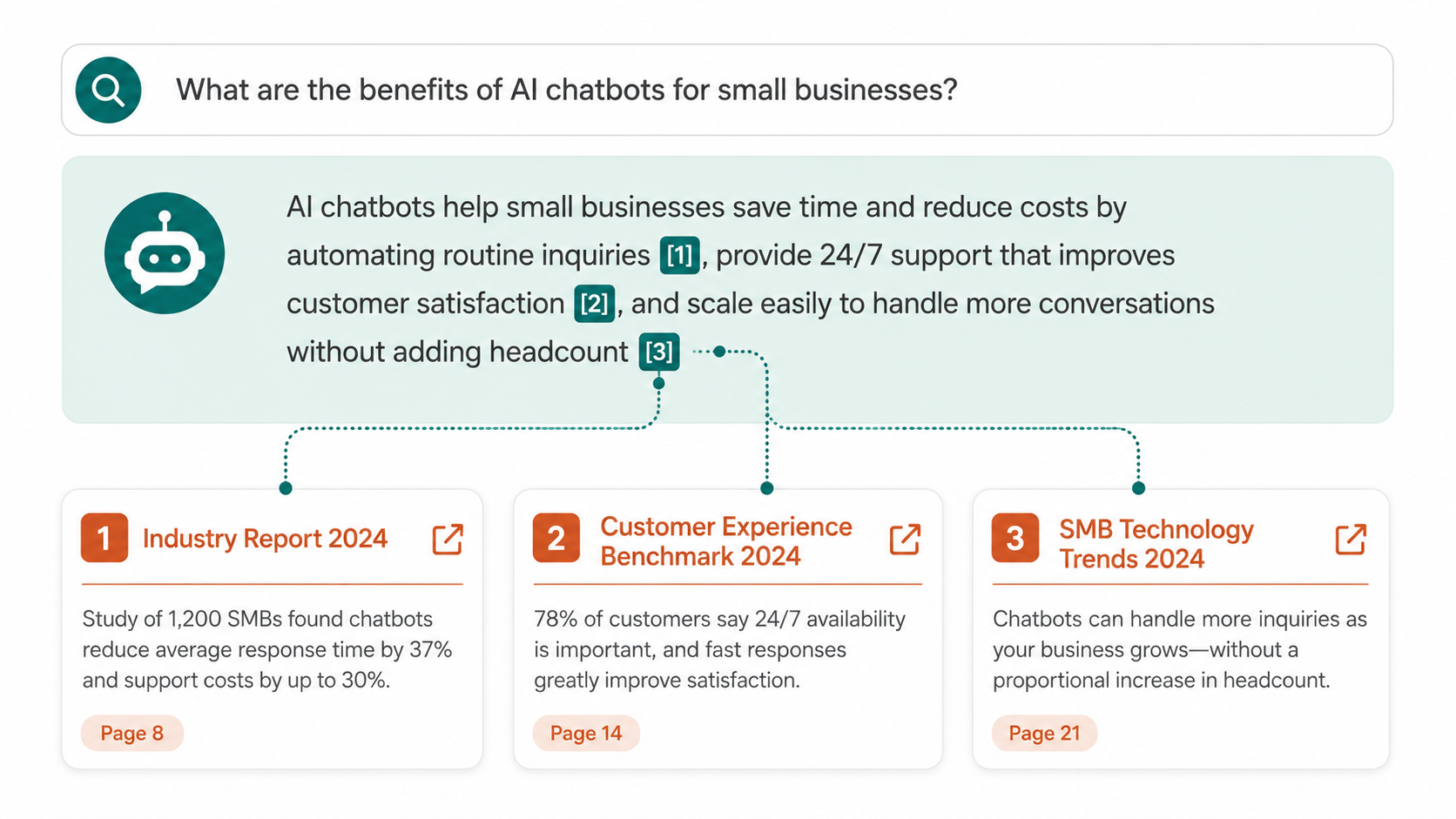
Perplexity is an AI research tool built for one thing: answering questions with sourced, cited responses drawn from the live web. Every answer comes with numbered citations you can click to verify. That’s not a feature they added later. It’s the entire foundation.
It doesn’t try to be everything. It’s not a general-purpose chatbot like ChatGPT. It’s not a creative writing partner like Claude. It doesn’t have the cultural reach of Grok or the ecosystem integration of Gemini. What it does is take a question, search the current web in real time, read dozens of sources, synthesize an answer, and show you exactly where every claim came from.
That narrower positioning is exactly why it flies under the radar. There’s no viral moment, no celebrity endorsement cycle, no daily discourse about what it said to someone. It’s a research tool. Research tools don’t trend.
But here’s what I’ve noticed: the people who use Perplexity regularly tend to be the ones making better-informed decisions. Not because the tool is smarter than the alternatives. Because it’s built to give you information you can trace back to a source, which changes how you think about every answer an AI gives you.
Why Perplexity Deserves a Closer Look in 2026
The platform has grown significantly since its early days. Conservative estimates put Perplexity at 30 to 45 million monthly active users for the core search product. That’s a fraction of ChatGPT’s scale. But the user base skews heavily toward professionals, researchers, and knowledge workers. According to one 2026 analysis, 64% of Perplexity users are using it for work-related research. This isn’t a toy. It’s a professional tool with a professional user base.
The reason it’s gotten so much better recently comes down to a few specific things that matter for how you and I work.
Real-Time Web Search with Inline Citations
Every Perplexity answer is grounded in live web data. This isn’t a language model guessing from training data. It actively searches, reads, and synthesizes. One independent audit found an average of 8.2 cited sources per answer, which is higher than any other mainstream AI search tool. You can click every citation. Some of them will be wrong, and I’ll get to that. But the default posture of showing your sources changes the dynamic between you and the AI fundamentally.
Multi-Model Access on the Pro Tier
Pro subscribers can switch between AI models per query. As of mid-2026, that includes GPT-5.4 and Claude Sonnet 4.6, along with Gemini 3.1 Pro and Perplexity’s own Sonar models. Different models have different strengths. Claude tends to produce more careful, nuanced analysis. GPT excels at structured reasoning. Having the option to pick the right model for each question is something I didn’t realize I wanted until I started using it.

30+ years of research strategy on projects for Oracle, Cisco, PayPal, and Walmart — now helping small businesses adopt AI that actually delivers.
More about George →Keep reading

AI renders faster and drafts proposals in minutes. But building codes, site conditions, professional liability, and field decisions remain structural limits no model handles.

Only 43% of associations can access their own member data. AI cannot fix what it cannot see. A practical guide to fixing the data foundation before buying AI features.

Solo architects and small design firms spend too many hours writing proposals that look like last month’s. AI can cut the assembly