
Most of Your Admin Work Shouldn’t Exist Anymore

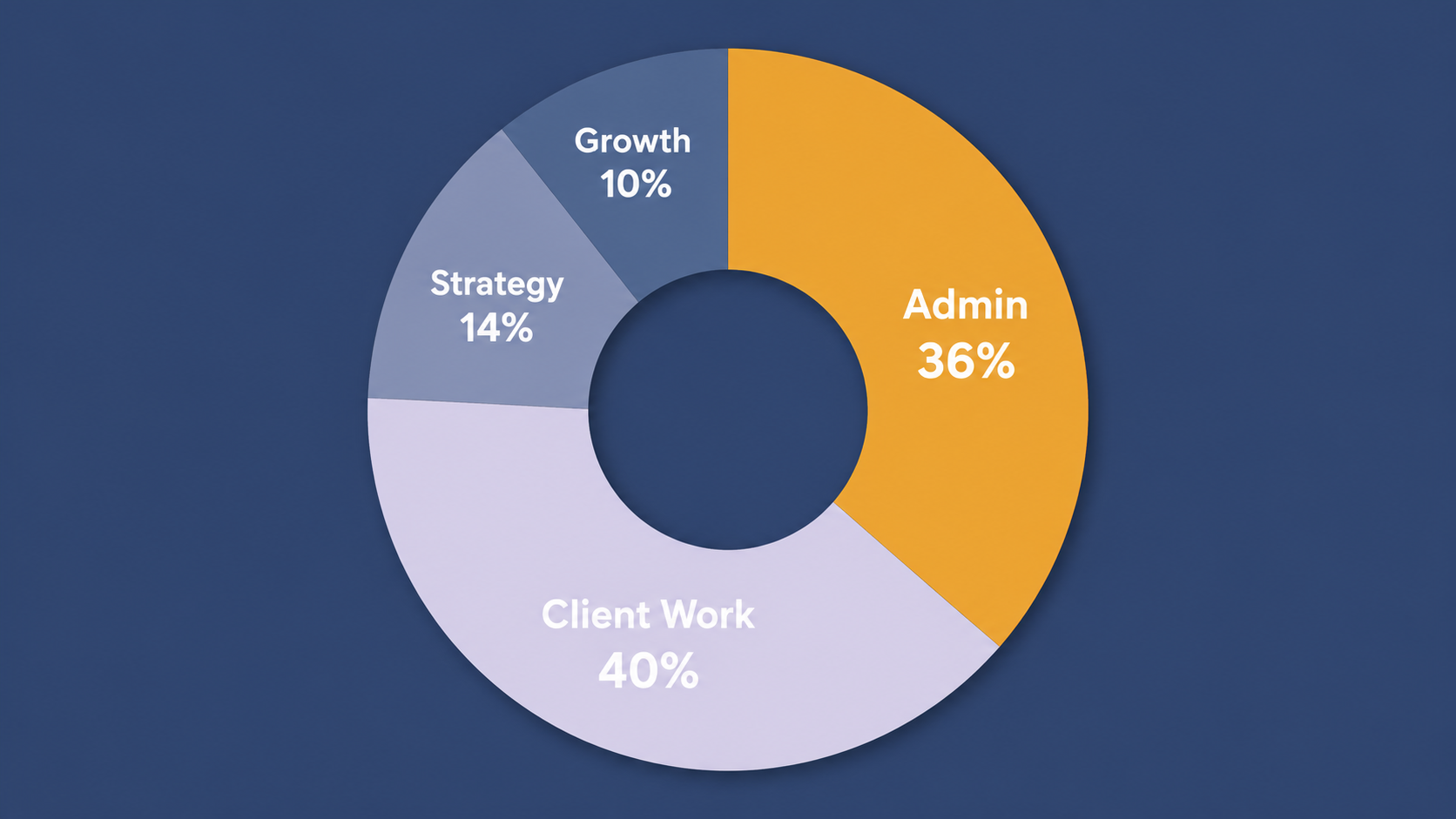
Small business owners spend 36% of their week on admin. AI automation tools are eliminating most of it. Here’s what that looks like in practice and how to start this week.
I’ve been asking small business owners how they spend their first hour of each workday. For-profit and nonprofit, whether they have five employees or fifty, the results are telling, although this is being done informally and not using larger datasets.
The first hour is almost never spent on the work the business exists to do. It’s email. It’s pulling a report someone asked for yesterday. Updating a spreadsheet that should update itself. Chasing an approval that shouldn’t need to be chased.
That pattern is consistent across industries. A Forbes-published survey of 251 entrepreneurs found that 36 percent of the average work week goes to administrative tasks. Not strategy. Not client work. Invoicing and data entry. Scheduling and expense tracking. The stuff nobody started a business to do.
Thirty-six percent. For an owner working a 45-hour week, that’s more than 16 hours spent on work that exists only because nobody has restructured it yet. Two hours a day at the rate most owners could bill for that time, and you’re looking at the equivalent of a part-time salary disappearing into tasks that nobody values.
The Time Problem Nobody Budgets For
The Small Business Expo surveyed 372 owners earlier this year and asked a straightforward question: what one change would most improve your business? Nearly half—46.5 percent—said more time. Not lower costs. Not better technology. More time.
That tracks with the conversations I have. The admin load isn’t one big problem. It’s dozens of small ones. Meeting notes that sit unwritten for three days. Reports that take two hours to assemble from three different sources. And then the scheduling. Six emails back and forth before finalizing a single meeting on a calendar.
None of these tasks are hard. That’s the trap. Each one takes ten or fifteen minutes; they feel manageable in the moment and compound quietly. By the end of a week, an owner or a two-person operations team has spent a third of their working hours on work that never moves the business forward.
What AI Automation Looks Like When It’s Practical
The phrase “AI automation” gets used loosely. In practice, for a small team, it means something specific: taking a task that follows a

30+ years of research strategy on projects for Oracle, Cisco, PayPal, and Walmart — now helping small businesses adopt AI that actually delivers.
More about George →Keep reading
Small businesses have no line item for AI. Costs are scattered across credit cards, subscriptions, and bundled software tiers. A guide to building your first AI budget.

Galyx.com: AI Guidance for Small Business. AI isn't just for companies with big budgets. It takes away mundane tasks so you can spend your time on your business.

AI coding tools build fast prototypes. But the gap between demo complete and commercially scalable is bigger than it looks. A framework for planning around it.