
Where AI Fails in Architecture Is Exactly Where Small Firms Win

AI renders faster and drafts proposals in minutes. But building codes, site conditions, professional liability, and field decisions remain structural limits no model handles.
The design firms I worry about most aren’t the ones that haven’t adopted AI yet. They’re the ones that adopted it without understanding where it stops being useful.
That distinction matters more in architecture and interior design than in almost any other profession. When a marketing agency lets AI generate a draft that misses the tone, the cost is a revision cycle. When an architecture firm lets AI generate a scope assumption that misses a code requirement, the cost is a claim against your errors and omissions policy and a premium increase that follows the principal for years.
I’ve spent the last year writing about AI tools that genuinely help small businesses. Rendering and concept generation are real wins. Proposal drafting (which I covered in a recent Galyx post) can be cut in half with the right process. The productivity gains are legitimate, and I’ve covered them extensively.
But there’s a second conversation that doesn’t get nearly enough attention: where AI fails. Not where it might fail in some hypothetical future, but where it reliably fails right now, on real projects, in ways that create financial and legal exposure for the licensed professionals whose names go on the drawings.
Those failure points aren’t temporary. They’re structural. And for solo practitioners and small firms, they represent something rare in a market being reshaped by technology: a durable competitive advantage that gets stronger, not weaker, as AI gets more capable.
The Wins Are Real. This Post Isn’t About Denying Them.
The RIBA AI Report found that architecture firms using AI jumped from 41% to 59% in a single year between 2024 and 2025. That’s an 18-point swing. A separate Chaos and Architizer study found that 86% of architects who use AI report that it saves them time, with the largest gains in visualization and rendering.
Those numbers track with what I see in practice. AI rendering tools have compressed what used to be an overnight turnaround into a ten-minute workflow. Concept imagery that once required an outside specialist now happens in the studio.
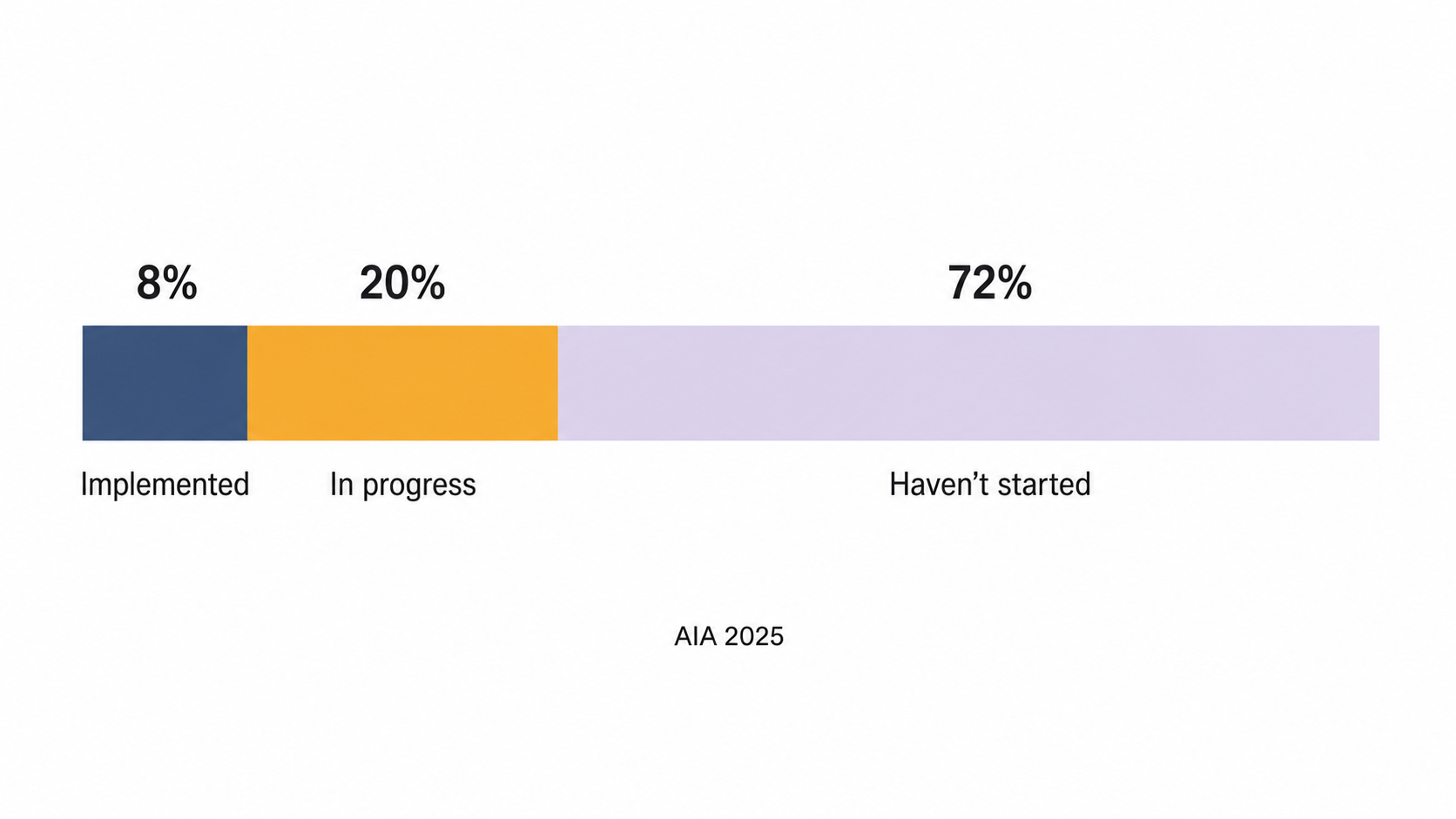
Those numbers miss something important, though. The AIA’s own 2025 research, based on a survey of 541 professionals, found that only 8% of US architecture firms have implemented AI into their practice. Another 20% are working on it. The rest haven’t started. Of those who have adopted it, only 6% use it regularly.
The question for the firms that are adopting it isn’t whether AI belongs in your practice. It already does in some form. The question is where to draw the line between tasks you can confidently hand to a model and decisions that require something no model has.
Five Limits That Won’t Be Fixed by the Next Model Release
The standard narrative says AI can’t match human “creativity.” That’s true, but it’s also the least useful framing. Creativity is abstract. The limits that matter in architecture practice are specific, concrete, and tied to money, law, and physical reality.
There are five of them. They aren’t bugs. They’re structural features of how buildings get designed, permitted, built, and insured. I’ll take them one at a time, starting with the one that shows up earliest in a project and ending with the one that matters most to your business.
Building Codes Change Faster Than Models Learn
Automated compliance checking has been a research goal for decades. LLM-based tools have made real progress. A 2026 systematic review in Building Research and Information evaluated every

30+ years of research strategy on projects for Oracle, Cisco, PayPal, and Walmart — now helping small businesses adopt AI that actually delivers.
More about George →Keep reading

Only 43% of associations can access their own member data. AI cannot fix what it cannot see. A practical guide to fixing the data foundation before buying AI features.

Solo architects and small design firms spend too many hours writing proposals that look like last month’s. AI can cut the assembly

AI is eroding the two things associations have always sold: information and credentials. The ones that survive will use AI to rebuild value, not automate admin.