
Your Association’s AI Problem Starts in the Database

Only 43% of associations can access their own member data. AI cannot fix what it cannot see. A practical guide to fixing the data foundation before buying AI features.
I worked on a technology standardization project a few years back for a large retail operation. Twenty-five people, a dozen different tools, no unified view of the customer. The sales team tracked prospects in one system. The service team logged issues in another. Marketing ran its own database. When a customer called, nobody could pull the full picture without opening three applications and comparing notes by hand.
The technology was not the problem. The tools were fine individually. The architecture was the problem. Information was scattered across systems that did not talk to each other, and no amount of training or process documentation could fix what was fundamentally a data infrastructure gap.
I am seeing the same pattern now in associations. Different industry, same structural failure. And the consequences are worse, because association leaders are trying to layer AI on top of that same kind of mess and expecting it to perform.
The Association Data Foundation That Does Not Exist
The numbers on this are stark. According to ASI’s 2026 Membership Performance Benchmark Report, only 43% of associations say they can easily access their own member data. Barely 30% effectively integrate their engagement tools, per ASAE research. Sequence Consulting’s analysis of the sector puts it plainly: the data needed to personalize, anticipate, and prove relevance is stuck in disconnected systems at the exact moment the value proposition is under pressure.
Consider what that looks like in practice. A membership director wants to identify members who attended the conference, completed a certification course, and opened fewer than half of the association’s emails in the past six months. That profile describes a member who may be disengaging. In a connected system, the query takes seconds. In most associations, it requires pulling exports from the event registration platform, the learning management system, and the email marketing tool, then matching records by hand in a spreadsheet. By the time the analysis is finished, the member has already decided not to renew.
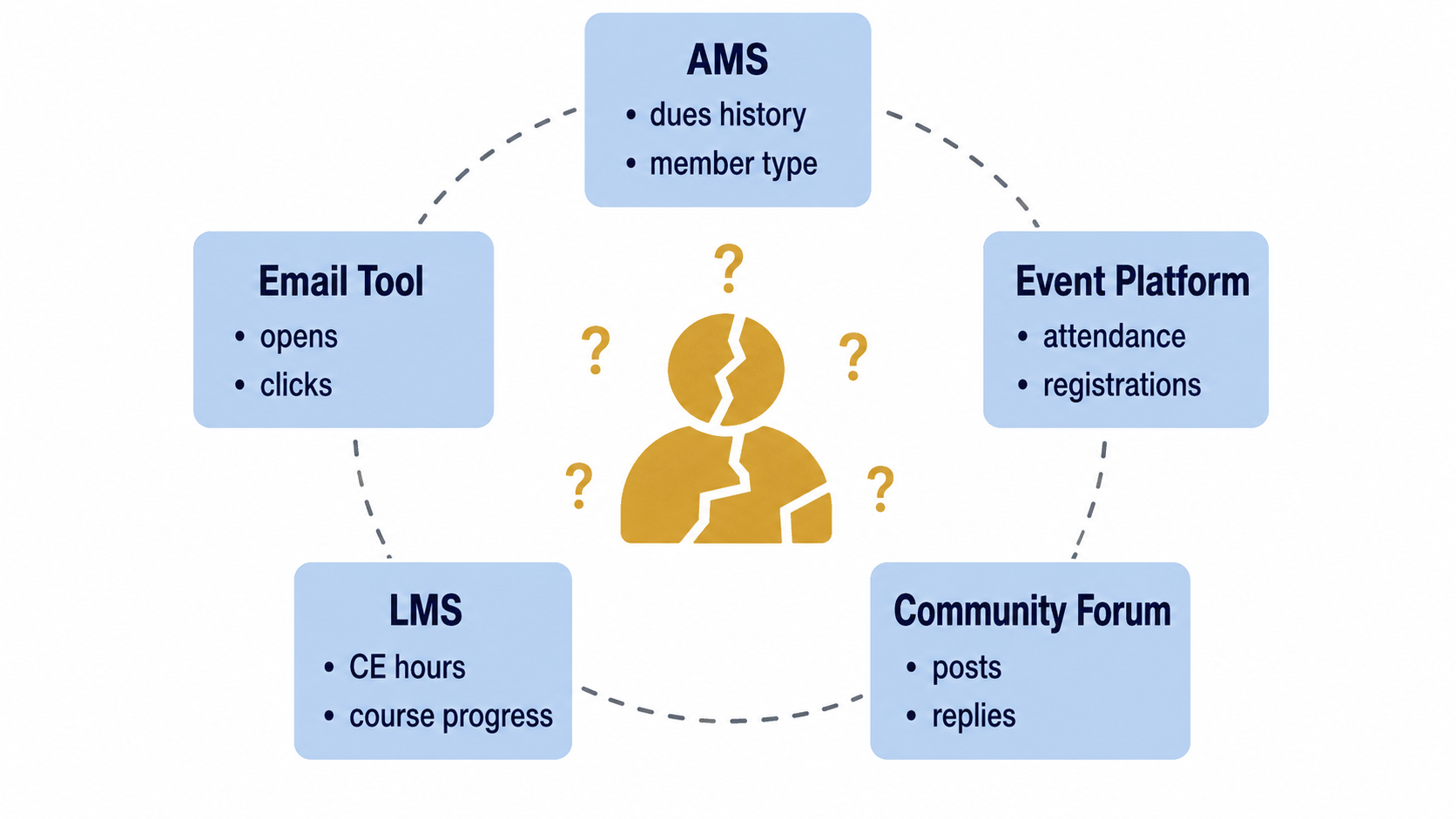
This is the foundation problem that undercuts every AI investment. AI is pattern recognition at scale. Feed it clean, connected data and it identifies signals you would never catch manually. Feed it fragments from five unconnected systems and it produces noise.
A typical five-thousand-member association might store member records in an AMS, event registrations on a separate conference platform, email engagement metrics in a marketing tool, continuing education completion in a learning management system, and community activity on a forum. Each system knows something about the member. None of them knows enough. And the AI features built into each individual system can only work with the data that one system contains. The event platform can tell you who attended. It cannot tell you whether that attendee is also overdue on certification hours and stopped reading the newsletter three months ago. That combination of signals is what predicts lapse risk. But assembling it requires a connected architecture most associations do not have.
The associations buying AI features before addressing the data layer

30+ years of research strategy on projects for Oracle, Cisco, PayPal, and Walmart — now helping small businesses adopt AI that actually delivers.
More about George →Keep reading

Solo architects and small design firms spend too many hours writing proposals that look like last month’s. AI can cut the assembly

AI is eroding the two things associations have always sold: information and credentials. The ones that survive will use AI to rebuild value, not automate admin.

Labor Day was created to honor human work. In 2026, AI handles the busywork. Here is what to automate and what to protect.