
AI Automation Was Already Cheap. Now It’s Good Enough.

The price of AI at small-business volume barely moved in a year. The cheapest models got much better. Five workflows now worth automating, and what they still need from you.
Run the numbers on five common business workflows using current API pricing from the major AI providers. Lead qualification. Invoice extraction. Email routing. Customer service triage. Content repurposing.
Now run them again at last year’s prices. The totals barely move. For a business handling a few hundred requests a month, the per-request cost of AI has been pocket change since at least last fall.
What did change is quieter, and it matters more. The models sitting at the bottom of each provider’s price list got much better, and the bottom of the price list is where most small businesses buy.
What Moved
Open OpenAI’s pricing page today and its cheapest model sits at about a tenth of what its predecessor launched at over the summer. Sounds dramatic. Read the history, though: that predecessor launched high and was marked down within weeks, so most of the drop is OpenAI correcting its own launch price.
Anthropic’s numbers tell a cleaner story. Its newest small model costs roughly a tenth of its predecessor per token, and Anthropic says it built the model for high-volume sorting and extraction. That’s the work most small businesses would automate first.
Google’s page deserves a slower read. Its Flash models are running at half price through the end of the year, and the list price that returns in January is higher than what last year’s Flash cost. (One step down, Google’s cheapest tier also costs more than last year’s version did.)
Line all three up against where the bottom of the market sat a year ago and the floor has barely budged. One of last fall’s budget models was even cheaper on input than OpenAI’s cheapest model today. The price held steady. What sits at that price got a generation newer, and noticeably better.
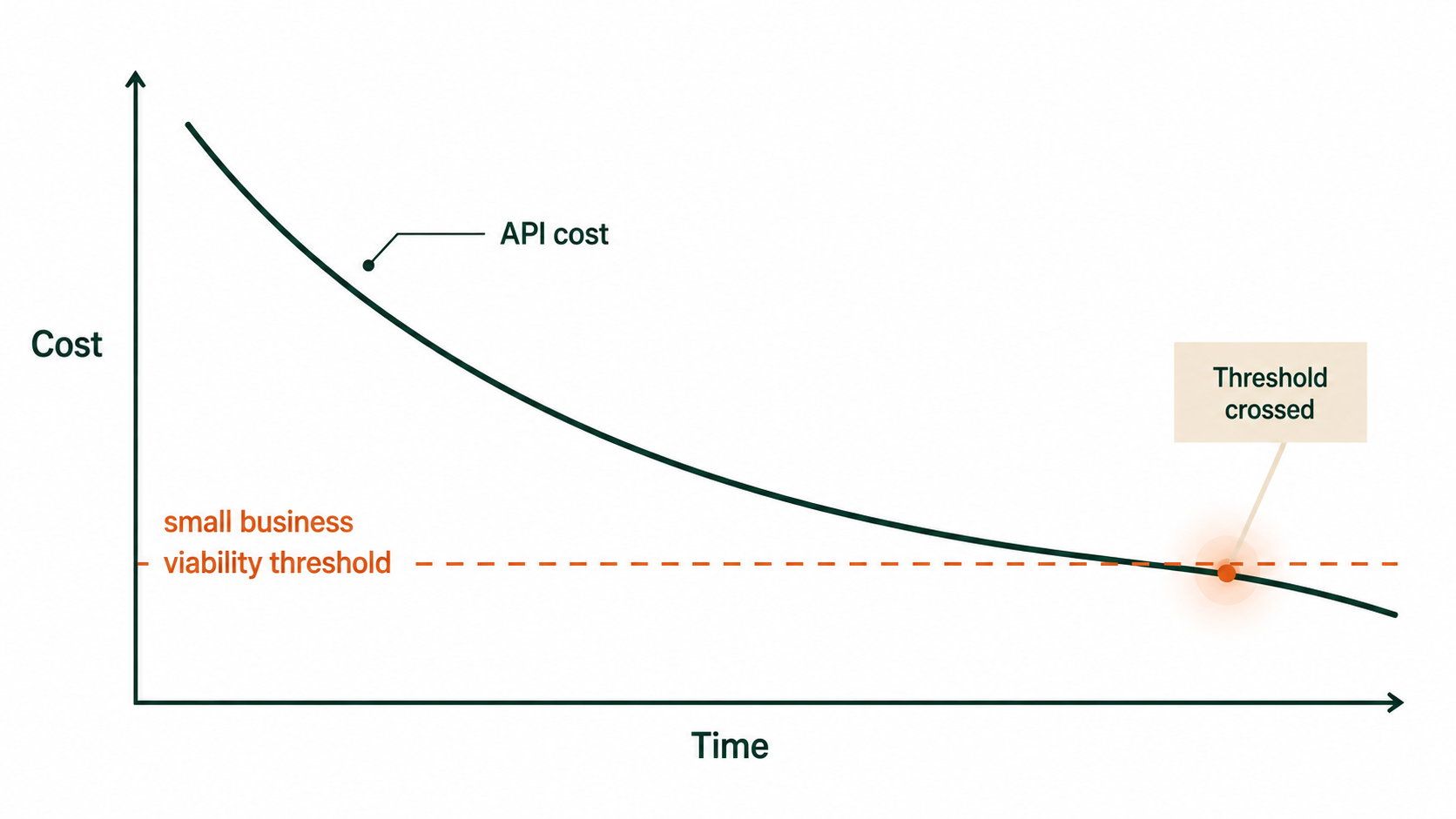
Earlier in the cycle, the cheapest models were cheap for a reason. They stumbled on multi-step reasoning and hallucinated on structured data, and their output needed so much cleanup that the labor savings evaporated. The current generation at that same price handles classification and extraction at a level that didn’t exist at any price two years ago. A cheap model that needs its work redone saves you nothing. Get the routine sorting right the first time, though, and the calculation changes.

30+ years of research strategy on projects for Oracle, Cisco, PayPal, and Walmart — now helping small businesses adopt AI that actually delivers.
More about George →Keep reading

AI renders faster and drafts proposals in minutes. But building codes, site conditions, professional liability, and field decisions remain structural limits no model handles.

Only 43% of associations can access their own member data. AI cannot fix what it cannot see. A practical guide to fixing the data foundation before buying AI features.

Solo architects and small design firms spend too many hours writing proposals that look like last month’s. AI can cut the assembly