
AI Tools That Scale with Your Business: A Practical Guide for Growing Companies

Most SMBs adopt AI but get stuck scaling. This guide reveals scalable AI tools for growing companies — CRM, automation, marketing AI — plus a proven 90-day framework.
We're in the middle of a shift that most business owners won't fully appreciate until it's too late.
The AI conversation has moved past "should I adopt?" That question is settled. According to McKinsey's 2025 State of AI report, 88% of organizations now use AI in at least one business function. The U.S. Chamber of Commerce found that small business adoption of generative AI jumped from 40% to 58% in a single year. The adoption wave already happened.
But here's what hasn't happened: most businesses haven't figured out how to scale AI beyond the first experiment. Only about a third of companies have moved past pilot mode. For businesses under $100M in revenue, that number drops to 29%, according to the same McKinsey data. The rest are stuck running disconnected AI tools that worked fine at one stage of growth and then quietly started failing at the next.
This is the new problem. Not whether to use AI, but whether the AI you're using can keep up with where your business is headed. And after 20-plus years of watching companies adopt (and abandon) technology, I can tell you: the AI tools for growing companies you pick in the first six months will either accelerate your next two years or create expensive drag you'll have to undo later.
Let's talk about how to get this right.
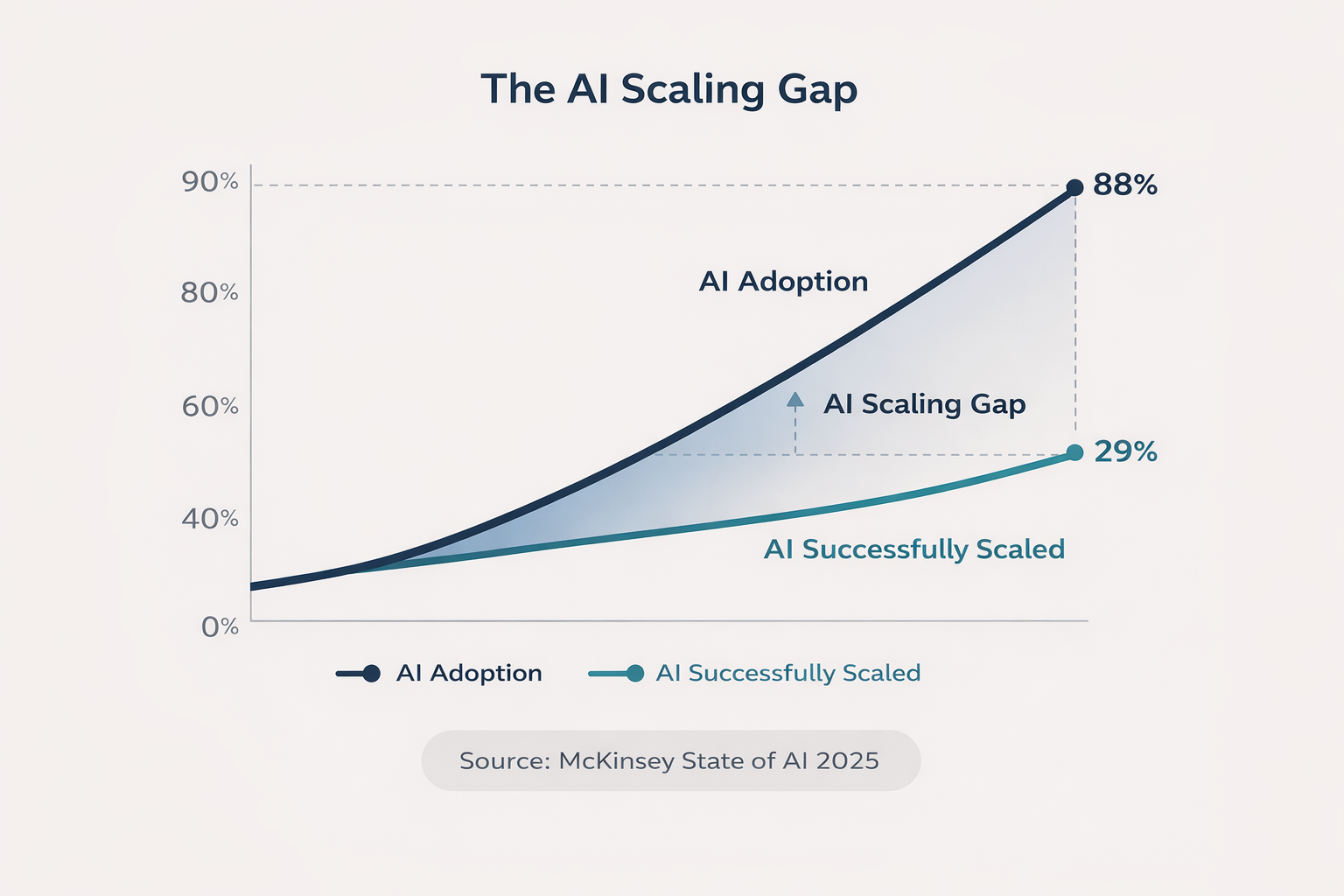
The Scaling Gap Nobody Talks About
There's a pattern I've been tracking across dozens of businesses, and it looks roughly the same every time. An owner signs up for an AI tool. It works. Things get faster, easier, and more organized. There's a brief honeymoon phase where everything feels like a revelation.
Then the business grows.
Maybe they add five employees. Maybe they triple their lead volume. Maybe they expand into a second market. And the tool that felt like magic six months ago starts straining. The free tier runs out of steam. The integrations can't handle the volume. The reporting that was "good enough" starts missing things that matter. Costs spike in ways nobody budgeted for.
This isn't a technology failure. It's a selection failure. Most AI tools marketed to small businesses are optimized for one stage: early. They're built for a solo operator or a team of three. Clean interfaces, simple pricing, five-minute setup. Genuinely useful at that scale.
The problem is that growth changes what you need. And most of these tools weren't designed to change with you.
Redefining What "Scalable" Actually Means
Software companies love the word "scalable." Usually, it means they have three pricing tiers and the top one costs ten times the bottom. That's not scaling. That's upselling.
When I talk about scalable AI tools for small business, I mean something specific. Five characteristics that determine whether a tool will still be useful in 18 months:

30+ years of research strategy on projects for Oracle, Cisco, PayPal, and Walmart — now helping small businesses adopt AI that actually delivers.
More about George →Keep reading

AI renders faster and drafts proposals in minutes. But building codes, site conditions, professional liability, and field decisions remain structural limits no model handles.

Only 43% of associations can access their own member data. AI cannot fix what it cannot see. A practical guide to fixing the data foundation before buying AI features.

Solo architects and small design firms spend too many hours writing proposals that look like last month’s. AI can cut the assembly