
AI-Optimized Operations: 2026 Guide for Small Businesses
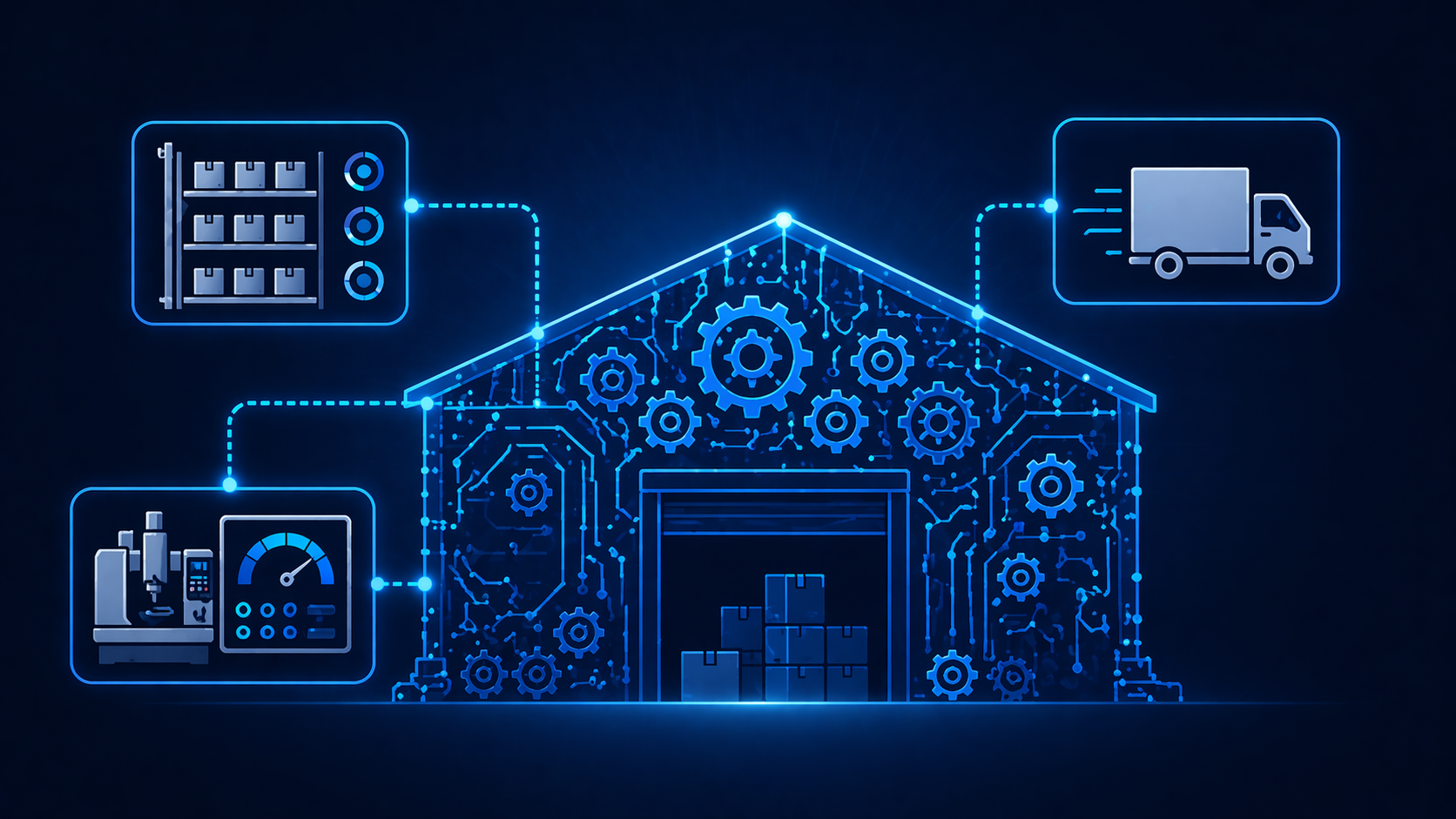
AI solves 'Stuck on Shelves' vs 'Backordered' issues in small biz. Cut inventory 20-30%, logistics 5-20%, breakdowns 70%. Tools like Netstock & MaintainX deliver agility.
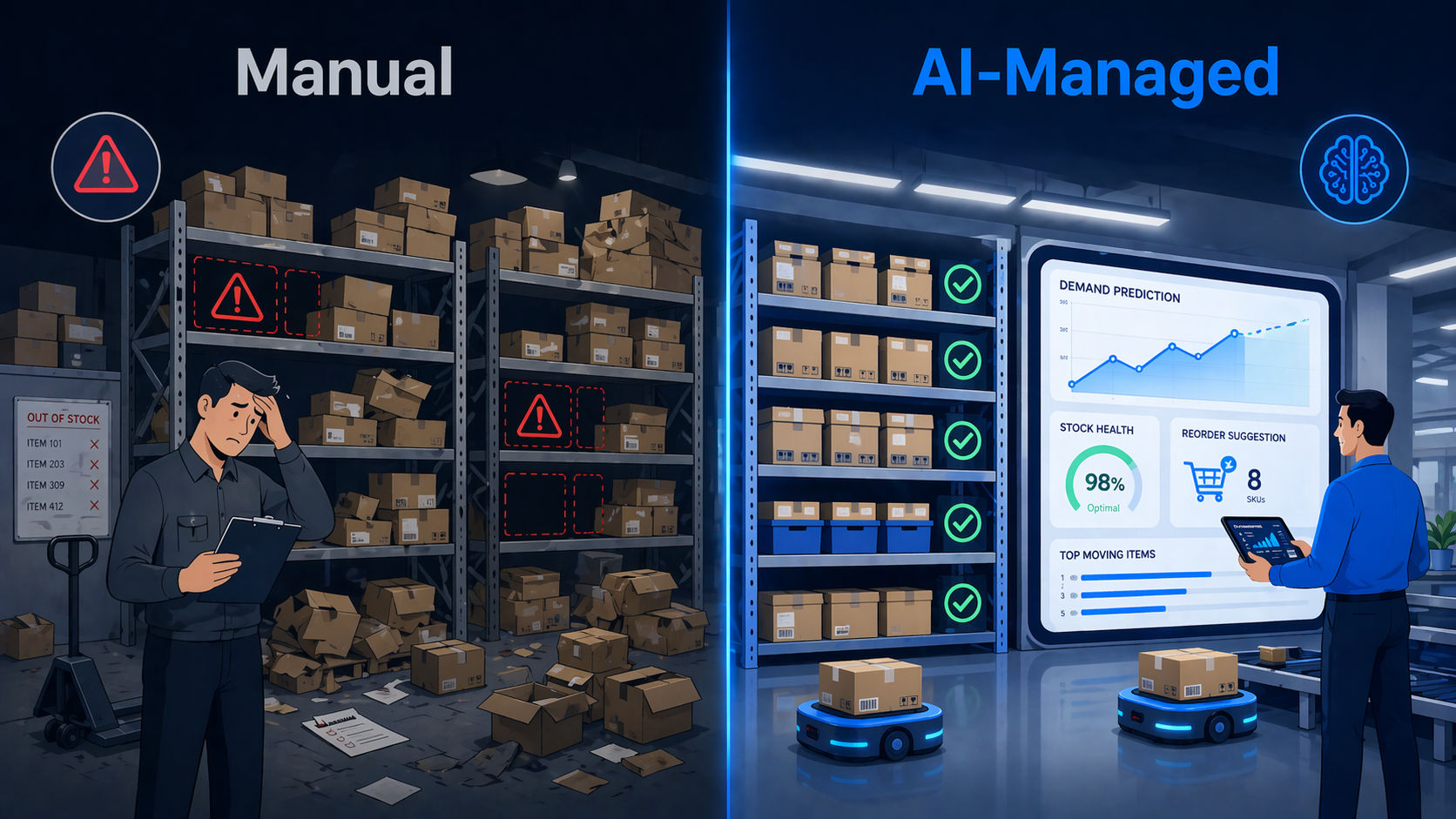
I walked into a plumbing supply company last week and noticed something on their whiteboard that told me more about the business than a meeting might have. They have thirty employees, two warehouses, and about $8 million in annual revenue. The whiteboard had two columns. One was titled "Stuck on Shelves." The other was titled "Backordered Again." Each column had about a dozen items written under it in different handwriting, in marker that had been smudged and rewritten more than once.
Sales were strong. Demand was strong. The problem on the whiteboard was the gap between the two. Overstocked on fittings nobody was ordering. The copper adapters were out of stock, which three contractors needed that week. He told me, "I feel like I am always one step behind."
I have seen versions of that whiteboard at probably forty different small businesses over the years. Different industries and different SKUs share the same two columns. And it is exactly the problem AI-optimized operations are built to solve.
The Operations Gap That Costs You More Than You Think
Most business owners do not measure the cost of operational inefficiency because they do not know how. It shows up as excess inventory tying up cash. It shows up as emergency orders with rush shipping fees because you ran out of something critical. It shows up as equipment downtime when a compressor, a conveyor, or a delivery van breaks down because nobody saw it coming.
McKinsey research on AI in distribution operations puts numbers on this. Embedding AI in operations can reduce inventory levels by 20% to 30%, logistics costs by 5% to 20%, and procurement spending by 5% to 15%. Add those up across a $5 million or $10 million operation, and the numbers get real fast. For most companies with tighter margins, a combined operational cost reduction approaching 30% in targeted areas can make the difference between a good year and a great one.
Salesforce's 2025 SMB Trends Report surveyed 3,350 small and medium business leaders. 91% of SMBs using AI reported revenue gains, and a separate finding was that 87% said AI helped them scale operations. I want to be careful with that 91% framing because people constantly misquote it. It does not mean a 91% revenue boost. It means 91% of SMBs that are using AI report some kind of revenue lift. The distinction matters, but the underlying signal is real. AI is moving capabilities that used to belong only to companies with dedicated operations teams down to the small business level.
Inventory and Supply Chain: Where the Money Hides
Back to my plumbing supply client for a second. His inventory problem was not bad instincts. He had been running this business for fourteen years. He knew his customers. The issue was volume and complexity. Thousands of SKUs, seasonal demand shifts, and contractor projects that spike orders with two days' notice. No human brain can track all of that and predict what is coming next week.
AI inventory management tools analyze historical sales data, seasonal trends, supplier lead times, and outside factors like weather and construction permit activity to predict demand with accuracy that spreadsheets can’t. McKinsey research shows AI-driven forecasting can reduce errors by 20% to 50% compared to traditional methods. For a regional distributor, that error reduction translates directly into freed working capital.

The real-world examples are not just from the Fortune 500. Distribution companies in the small and mid-market range have used AI planning to recover meaningful chunks of excess inventory and cut planning time by significant percentages. The point is not the headline number from any single case study. The point is that the pattern is consistent. Better forecasting leads to less excess inventory, fewer stockouts, and a real cash flow improvement.
For SMBs, the tools are becoming accessible. Platforms like Netstock, Lokad, and Cin7 offer AI inventory management built for businesses without a dedicated supply chain team. Most connect directly to your existing accounting or ERP software. Pricing varies and changes often, so check vendor sites directly, but there are options under several hundred dollars a month. The barrier to entry has dropped sharply over the past two years.
Predictive Maintenance: Stop Fixing Things After They Break

If your business depends on equipment of any kind, this section is worth your full attention.
Deloitte's research on predictive maintenance found that the technology can reduce maintenance costs by up to 25% and increase equipment uptime by 10% to 20%. Their position paper on the topic also reported that, on average, predictive maintenance increases productivity by 25% and reduces breakdowns by 70%. Those are staggering numbers when you think about what unplanned downtime costs a small manufacturer, a fleet operator, or a restaurant with a walk-in cooler on the fritz.
The concept is straightforward, even if the technology behind it is sophisticated. Sensors on your equipment collect data on temperature, vibration, pressure, and performance. AI models analyze that data against historical patterns and flag when something is trending toward failure. Instead of waiting for the breakdown or replacing parts on a fixed schedule, whether they need it or not, you intervene precisely when the data tells you to.
These approaches scale down. IoT sensor kits and cloud-based monitoring platforms from companies like UptimeAI, MaintainX, and Fiix put predictive maintenance within reach of smaller operations. You do not have to instrument your entire business on day one. You start with the equipment whose failure would cause the biggest pain, and you work outward from there.
The competitive advantage here is not just savings. It is agility. When your equipment stays running because an algorithm flagged a bearing issue three weeks early, you deliver on time while the other guy is scrambling.
The Real Edge: Agility, Not Just Cost Savings
Cost reduction gets the headlines. But the business owners I talk to who have adopted AI-optimized operations tell me the bigger benefit is agility. When you can see demand shifts in real time, you react faster than competitors still working off last month's numbers. When your equipment stays running because an algorithm flagged a bearing issue three weeks before it would have failed, you deliver on time while the other guy is scrambling.
The Salesforce data backs this up. Growing SMBs are roughly twice as likely to have integrated tech stacks compared to declining ones (66% versus 32%). It is not just about having AI. It is about having systems that talk to each other so the intelligence flows across your entire operation.
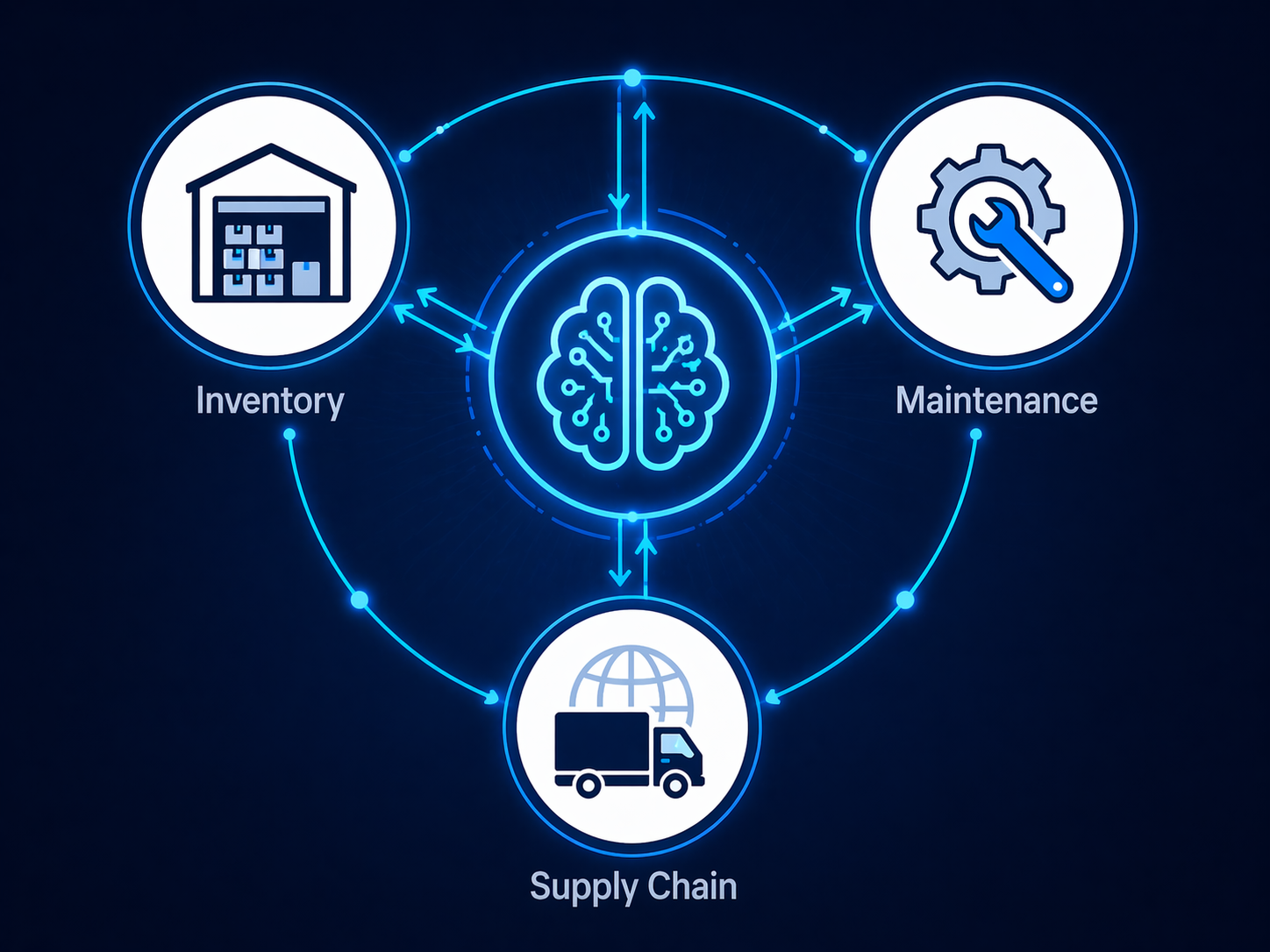
Here is what smart automation for SMBs looks like in practice when the pieces connect:
Demand forecasting feeds inventory planning. AI predicts a spike in orders for a product line based on seasonal patterns and a new housing development in your service area. Your purchasing system automatically adjusts reorder points.
Inventory data feeds financial planning. Lower excess inventory frees up cash that your AI financial tools identify and redirect toward a marketing push during your strongest selling period.
Equipment monitoring feeds scheduling. Predictive maintenance flags that your main delivery truck needs brake service in two weeks. Your operations software automatically updates routes to accommodate the scheduled downtime.
Supply chain visibility feeds customer communication. A supplier delay triggers an automatic notification to affected customers with revised delivery timelines before they call to ask.
None of these requires a team of data scientists. They require tools that integrate with each other and an owner willing to spend the time connecting them.
What Can Go Wrong (And Probably Will, At First)
I would be lying if I told you this was easy. The challenges I see most often:
Integration is the hard part. The AI tool itself usually works fine. Getting it to pull data cleanly from your accounting software, your POS system, your CRM, and your supplier portals is where the friction lives. Before you buy any AI for SMBs platform, ask the vendor exactly which systems it connects to natively and what requires custom work. If the answer involves "API development," budget accordingly.
Dirty data will ruin your forecasts. If your product categories are inconsistent, your inventory counts are off, or your sales data has gaps, the AI will produce confident-looking predictions built on a shaky foundation. Clean data is the prerequisite for every tool I have mentioned in this post. Not glamorous work. Essential work.
Black swan events do not care about your models. A tariff announcement, a port closure, a key supplier going bankrupt. AI models learn from historical patterns. Unprecedented disruptions will catch them off guard the same way they catch you. Use AI forecasts as your best available estimate, not as a guarantee.
Change management is real. Your warehouse manager who has been ordering based on gut instinct for fifteen years is not going to trust an algorithm overnight. And sometimes the gut instinct is right. The goal is not to replace experience. It is to augment it with data. Frame it that way and you will get better buy-in.
The Ethical Dimension You Should Not Ignore
When AI optimizes your operations, it makes decisions that affect people. Scheduling algorithms that optimize labor costs can also squeeze workers into unpredictable shifts. Inventory automation that reduces headcount in a warehouse changes livelihoods. Predictive models that flag certain suppliers as "risky" can inadvertently disadvantage smaller or newer vendors.
I am not saying do not use these tools. I am saying use them with awareness. If your AI scheduling system is optimizing for cost at the expense of employee well-being, you will lose your best people. If your supply chain AI consistently sidelines local suppliers in favor of cheaper alternatives, you are building fragility into a system that is supposed to create resilience.
Trust cuts both ways. Your employees and your suppliers need to trust how you are using these tools. The Salesforce data shows that 81% of SMB leaders said they would spend more on technology from trusted vendors. Your suppliers and employees are running the same calculation about you.
Where to Start This Week

If inventory is your pain point. Look at Netstock, Cin7, or your existing accounting software's built-in forecasting (QuickBooks and Xero both have partners in this space). Start with demand forecasting for your top 20% of SKUs. That is where the Pareto principle works in your favor.
If equipment downtime is your problem. Start small. IoT sensor kits from providers like MaintainX or Fiix can monitor your most critical pieces of equipment for a few hundred dollars per asset. You do not need to instrument your entire operation on day one.
If you want the big picture. Map your current systems. List every piece of software your business touches and identify where data flows smoothly and where it does not. The gaps in that map are where AI automation for small business can create the most value. Automation platforms like Zapier, Make, and n8n can connect many of these systems without custom development.
The Salesforce 91% number is not about companies that went all-in on a single platform. It is about businesses that identified specific operational problems, picked tools that addressed those problems, and connected them to their existing workflows. Start with one problem. Prove the value. Then expand.
My plumbing supply client started with one AI inventory tool connected to his existing ERP. Six weeks in, his whiteboard had one column instead of two. The handwriting was still smudged. But the column got shorter every week, and that was the part that mattered.
Good decisions start with good information. Galyx is built for business owners who know AI matters and need a technology partner who actually speaks their language and solves real business problems. Galyx focuses on practical guidance you can use now.
Register at Galyx.com for more insights and guidance.

30+ years of research strategy on projects for Oracle, Cisco, PayPal, and Walmart — now helping small businesses adopt AI that actually delivers.
More about George →