← Back to Blog

AI Employee Engagement: What Works for Small Teams in 2026

By George PapazianApril 4, 20269 min read
AI ToolsLeadershipProductivityStrategy
AI Employee Engagement: What Works for Small Teams in 2026

AI tools are helping small teams boost engagement and cut turnover. Learn how pulse surveys, sentiment analysis, and smart onboarding are working for SMBs in 2026.

I have a habit of saving articles I do not have time to read. Last weekend, I finally opened the folder. About forty tabs deep, I hit a stretch on AI and employee engagement that pulled me sideways for an entire afternoon. What I came out with was not the story I expected to find.

Most small business owners I work with think of AI as something that handles the outside of the business. Customer emails. Marketing copy. The occasional proposal. The inside of the business, the team dynamics, the morale, the quiet question of how everyone is really doing, still feels like something you handle in person, over coffee, on a Friday afternoon.

The data is pointing in a different direction. And if you run a team somewhere between five and fifty people, you should know what is happening before your competitors do.
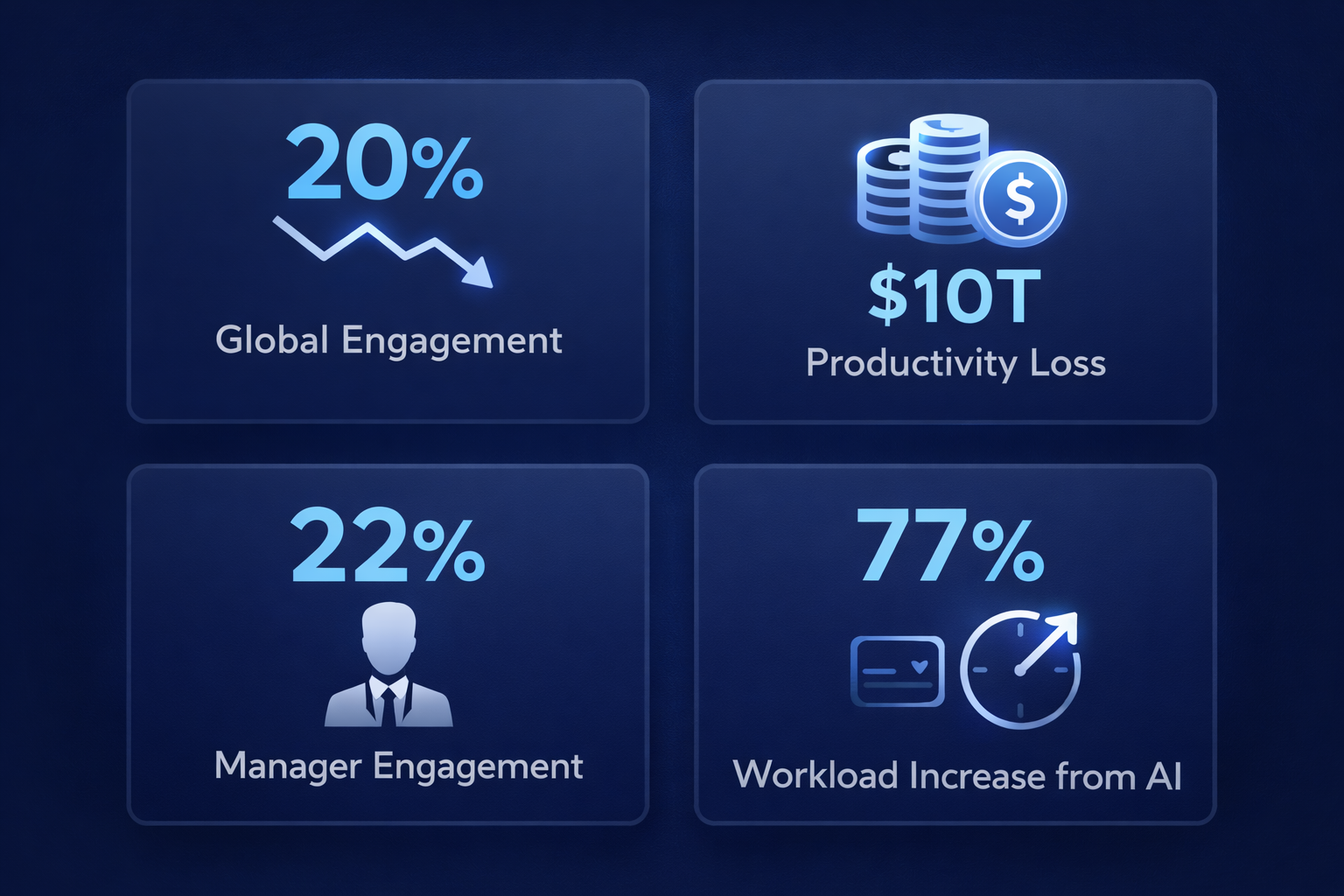
The 2026 engagement gap, by the numbers.

The Engagement Problem Nobody Talks About at Small Companies

Gallup just released its State of the Global Workplace 2026 report. It is uncomfortable reading. Global employee engagement fell to 20% in 2025, the second consecutive year of decline and the lowest level since 2020. Gallup pegs the cost of disengagement at roughly $10 trillion in lost productivity, about 9% of global GDP. That is not a Fortune 500 problem in a vacuum. It cascades down into 8-person HVAC shops, 15-person marketing agencies, and 22-person manufacturing operations.

The thing that caught my eye in the new Gallup numbers was the manager piece. Manager engagement dropped from 27% to 22% in a single year. Gallup CEO Jon Clifton went on record saying businesses are pouring money into AI, but the results are not showing up on the bottom line, and that the missing piece is the manager. In a small business, the owner is the manager. So this is your problem, whether you wanted it or not.

The shape of the engagement problem at small companies is different from the Fortune 500 version. You probably do not have a dedicated HR director watching dashboards. You do not run quarterly engagement surveys. You are close enough to your team to notice when someone is off. The problem is that proximity creates its own blind spots.

You miss the friction building between two team members. You do not realize one of your best people has felt underutilized for three months. You have a great culture on paper and a slow leak in the day-to-day reality, the kind you do not notice until the tire is flat.

AI does not replace the human judgment you bring to your team. It gives you the data layer you have been missing.

Tools designed for small business HR are starting to close that gap. Not by replacing your judgment. By giving you the data layer you have been missing.

What AI Employee Engagement Tools Really Do
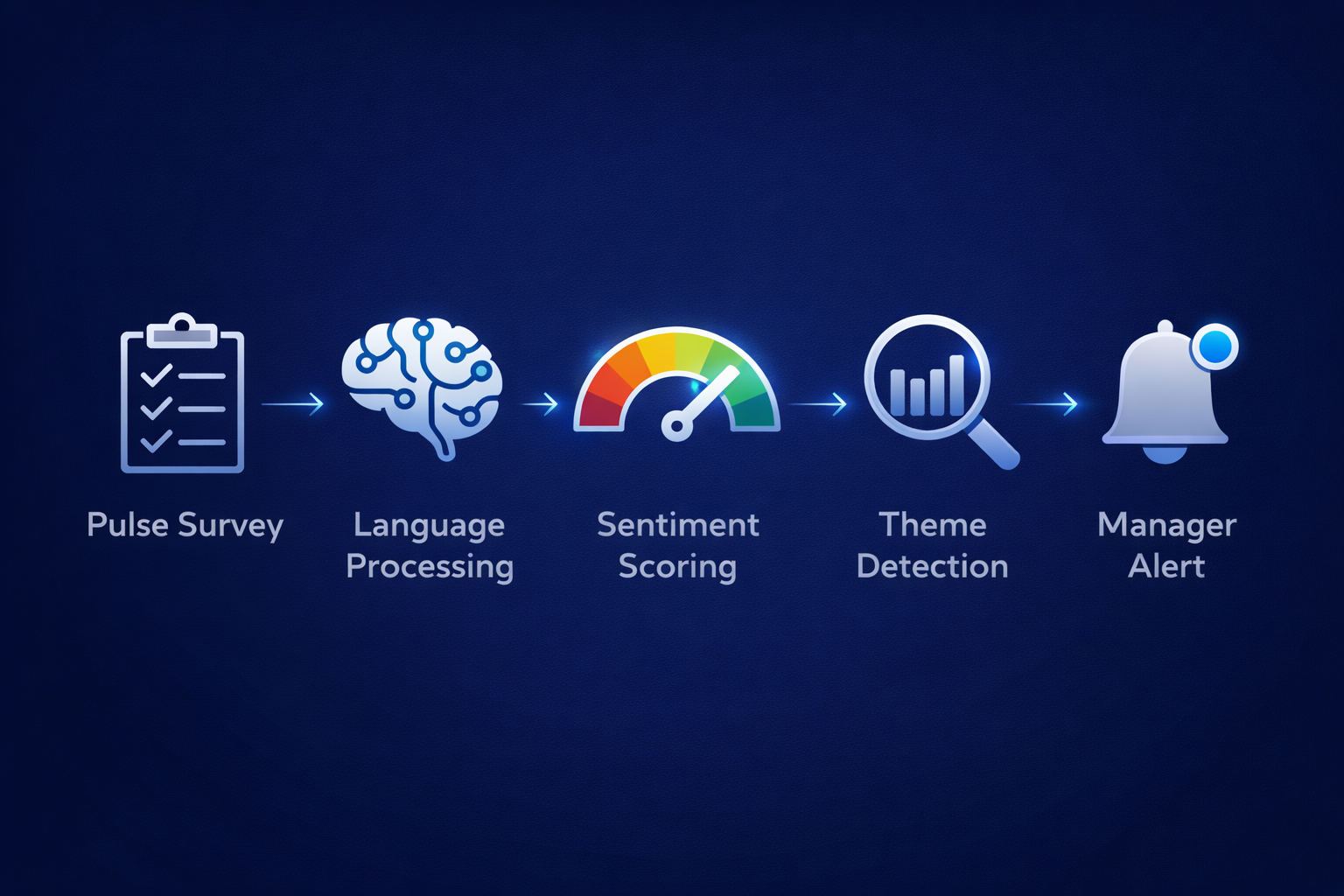
From raw feedback to real-time insight: how AI sentiment analysis works.

"Sentiment analysis" sounds like something out of a corporate memo. Let me make it concrete.

You run a quick pulse survey after a rough project week. Your team submits a mix of numerical ratings and short written responses. The old way, you read through the comments, maybe spot a theme or two, and move on. With AI-driven tools, the system does something different. It processes the language in those open responses, identifies emotional tone, flags recurring themes, and surfaces patterns you would not catch in a five-minute read.

Platforms like Culture Amp, Workleap, Lattice, and 15Five now use natural language processing to turn qualitative feedback into something you can act on. The system does not just report that morale is "neutral." It tells you that three people on your installation team used language consistent with resource strain, and that one senior employee's response pattern has shifted noticeably in the last sixty days.

That kind of early detection matters. In a team of eight, catching a friction point at week two instead of week ten is the difference between a conversation and a resignation letter.

The Platforms Worth Looking At for AI Employee Engagement

A few worth knowing about at the SMB price point. Pricing here is current as of April 2026, but check the vendor sites before you commit. This category moves fast.

  • Culture Amp. Strong on qualitative feedback analysis with industry benchmarking. Their small business plan starts in the per-employee-per-month range, with custom pricing once you scale. Solid choice if you want comparison data against companies like yours.

  • Workleap. AI-generated eNPS analysis with trend summaries, a clean interface, and easy for non-HR users. Integrates with Slack and Teams, which removes a lot of friction at small companies.

  • Lattice. Pulse surveys plus AI-driven manager coaching prompts. Better suited if you have ten or more employees and want performance and engagement living in one tool.

  • 15Five. Strong recurring check-in workflow with AI summarization and coaching prompts. Works well if your team is comfortable with structured async updates.

  • AttendanceBot. For very small teams, this one lives inside Slack and Microsoft Teams. It runs sentiment pulse checks without making people log in to a separate platform. Lower friction, higher participation rates. Matters when your sample size is eight people.

None of these require an HR team. Most need a day of setup and someone willing to look at the results. That second part is where most of the value gets won or lost.

Onboarding: Where the Quickest Wins Live

Manual versus AI-assisted onboarding: the difference in a new hire's first 90 days.

New hire onboarding is one of the most underrated levers in a small business. When it goes badly, you feel it for months. The person takes longer to get up to speed. Teammates get frustrated filling the gaps. You spend more time than you wanted managing a situation that should have been set up for success on day one.

The HR tech industry has been steadily moving AI into onboarding workflows over the past two years. Tools like Gusto, Rippling, and BambooHR now use AI to personalize the new hire checklist, surface the right training materials based on the role, and trigger automated check-ins at day 7, day 30, and day 60. The new hire gets a consistent experience without you having to manually shepherd every step.

At a more sophisticated level, AI onboarding tools analyze early sentiment signals from new employees. If someone is expressing confusion or frustration in their check-in responses, the system flags it for the manager before week two. You catch misalignment when it is still cheap to fix.

I worked with a 14-person accounting firm last year. Her onboarding process was entirely verbal. A tour, a week of shadowing, and a "just ask if you have questions" approach that worked fine when everyone sat in the same office. After switching to Rippling with AI-assisted onboarding flows, she told me the first three months with new hires felt different. Less hand-holding. More confident starts. And one moment where the system flagged a new hire's check-in responses as showing role confusion that she probably would not have caught until month two.

In a team of eight, catching a friction point at week two instead of week ten is the difference between a conversation and a resignation letter.

Personalized Recognition Without a Dedicated HR Team

One real advantage AI brings to a small business workforce is the ability to personalize recognition, development, and communication without the overhead of a full HR function.

Big companies can afford tiered recognition programs, dedicated managers for individual development conversations, and quarterly engagement initiatives with full-time staffing behind them. Most SMBs cannot. What they can do is use AI tools that handle the personalization work in the background.

Here is what that looks like in practice:

  • Personalized recognition cadences. Tools like Kudos and Bonusly use AI to analyze contribution patterns and prompt timely peer recognition. Instead of a generic monthly shout-out, team members get recognized for specific behaviors that align with company values, triggered based on actual activity.

  • Individualized coaching prompts. Lattice and 15Five use engagement data to generate manager talking points specific to each team member. If your data shows someone is craving more challenge, the AI surfaces that in your next one-on-one prep.

  • Communication tone calibration. Some AI tools now help managers tailor their approach to different employees. The engineer who wants direct bullet points needs a different update email than the salesperson who wants context and enthusiasm.

  • Early attrition signals. This might be the highest-value use for small teams. Losing one person in a 10-person company is a 10% capacity loss. Tools that flag disengagement early give you time to intervene, adjust responsibilities, or have the conversation that changes someone's trajectory.

Again, none of this requires a dedicated HR professional. It requires someone willing to set things up and act on what surfaces.

The Honest Reality: Why This Does Not Work on Autopilot

Adoption fails when it is done to people, not with them. Get these four steps right.

I would be doing you a disservice if I stopped there. The rollout of any AI engagement tool inside a small company comes with friction. The friction is mostly human, not technical.

An Upwork study published in 2024 surveyed 2,500 workers and found that 77% of employees using AI said the tools had increased their workload, and 47% had no idea how to achieve the productivity gains their leaders expected. Upwork's 2025 follow-up was a little brighter on the productivity side (workers using AI reported a 40% boost on average), but 88% of the highest-productivity users also reported burnout. The technology was rarely the problem. The change management was.

For small businesses, where trust between owner and team is personal and sometimes delicate, that miscommunication costs more. If your team thinks you are tracking sentiment because you are looking for reasons to let someone go, they will give you useless data. If they think you are tracking it because you genuinely want to make things better, they will give you an honest signal.

A few things that matter in rollout:

  • Tell people what you are doing and why. "I am using a pulse survey tool so I can understand how the team is doing and catch problems before they get big." That sentence takes twelve seconds to say and prevents months of suspicion.

  • Start with onboarding and low-stakes feedback. Do not open with real-time sentiment monitoring on your existing team. Start somewhere where the data is less charged.

  • Close the loop. If someone gives feedback that leads to a change, say so. "We heard the project handoff was confusing, so we are changing it." That is the difference between a feedback culture and a survey graveyard.

  • Do not automate authenticity. AI-generated recognition messages that feel templated will hurt engagement. Use AI to know when and who to recognize. Write the message yourself.

The Ethical Dimension You Cannot Skip

When you use AI to analyze employee sentiment, you are collecting real emotional data from real people. That comes with responsibility.

The platforms worth trusting have a few things in common. They anonymize individual feedback before presenting aggregate insights. They give employees access to their own data. And they do not let managers drill down to individual comment-level data unless the employee has explicitly opted in. If the tool you are evaluating does not have clear answers on those points, keep looking.

There is also a subtler issue. These tools can create a false sense of certainty. A sentiment score goes up, and you assume things are fine. But scores are approximations. A team member dealing with something personal might not show up in your engagement metrics at all. The data informs your leadership. It does not replace it.

Use these tools to ask better questions, not to stop asking them. The AI employee engagement tools that genuinely improve morale are the ones where the data leads to a real conversation, not a slide deck.

Where to Start This Week

If you are running a team between five and fifty people and you have not looked at any of this yet, here is a path forward:

  • Spend twenty minutes looking at AttendanceBot, Workleap, or Culture Amp. Most offer free trials.

  • If you already use Rippling, Gusto, or BambooHR, look at what engagement and onboarding AI features are included in your existing plan. You are probably not using them.

  • Run one pulse survey this month. Five questions. Tell your team why. Share what you learn within ten days.

  • Ask yourself one honest question: of your current team, how many would say they genuinely enjoy coming to work? That number is your baseline.

None of this is magic. It is what happens when you consistently pay attention to how your team is doing, use better tools to catch what you would otherwise miss, and act on what you learn.

That is not AI doing the work. That is you doing the work better.

Good decisions start with good information. Galyx is built for business owners who know AI matters and need a technology partner who actually speaks their language and solves real business problems. Galyx focuses on practical guidance you can use now.

Register at Galyx.com for more insights and guidance.

Share
George Papazian
About the author
George Papazian
Founder & AI Strategy Consultant, Galyx

30+ years of research strategy on projects for Oracle, Cisco, PayPal, and Walmart — now helping small businesses adopt AI that actually delivers.

More about George →
Related posts

Keep reading