
AI Cash Flow Forecasting: How Small Businesses Are Closing the Visibility Gap
Small businesses using AI cash flow forecasting close the visibility gap and avoid cash crunches. Discover practical tools delivering real results in 2026.
I ran the numbers on a client's AI spending last week, and what I found surprised both of us. He had been paying for four different finance tools that overlapped on cash flow forecasting and credit risk, none of them connected to each other, and the most useful one was a feature already included in his QuickBooks subscription that he had never turned on.
That conversation pulled me into the data on what is happening with AI cash flow forecasting at small businesses right now. The picture is interesting, and it is not the picture most vendor pitches paint.
Salesforce surveyed 3,350 small and medium business leaders for the sixth edition of their SMB Trends Report. 91% of SMBs using AI said the technology was boosting their revenue. That number gets quoted a lot, and almost always inaccurately. It does not mean AI delivers a 91% revenue increase. It means 91% of SMBs that have adopted AI report some kind of revenue lift from it. The distinction matters because the second framing is real, supported by 3,350 responses, and useful. The first framing is the kind of stat that gets businesses to buy tools they do not need.
The category where I am seeing the biggest practical gains right now is finance. Specifically, AI cash flow forecasting and AI credit risk assessment. These tools are quietly reshaping how smaller companies see money coming in, manage what is going out, and avoid the kind of cash crunches that kill otherwise healthy businesses.
The Cash Flow Visibility Problem Nobody Wants to Talk About
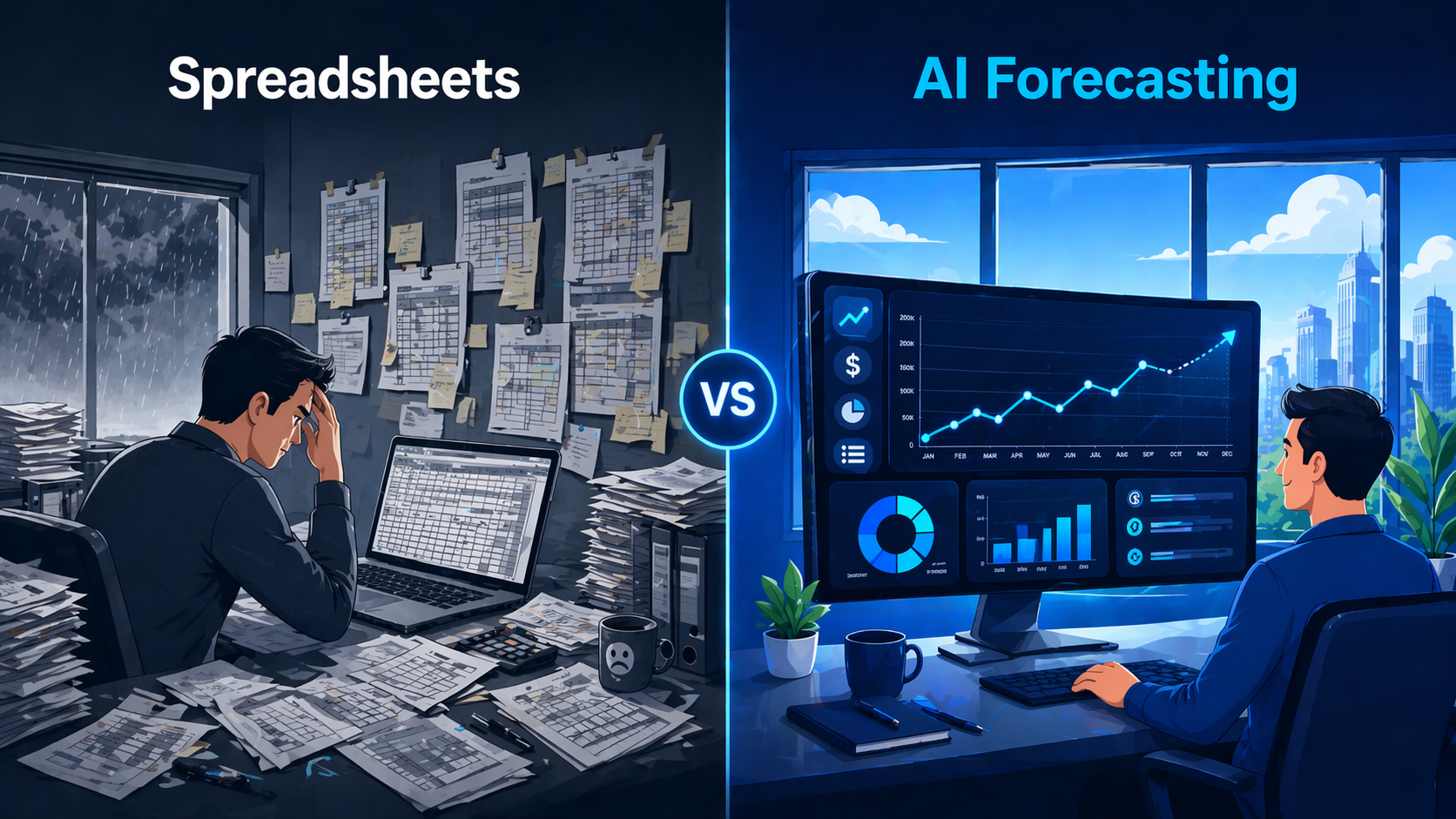
Here is the stat that should stop every small business owner cold. A widely cited U.S. Bank study found that 82% of small business failures trace back to poor cash flow management. Not bad products. Not weak demand. Cash flow. These businesses were making money. They just could not see far enough ahead to manage it.
This is the daily reality for most businesses under $100M in revenue. You are running your finances on a combination of QuickBooks reports, gut instinct, and a spreadsheet your bookkeeper updates every Friday. It works. Until it does not.
AI cash flow forecasting tools change this equation by pulling real-time data from your bank accounts, accounting software, invoices, and payment history. Machine learning spots patterns you would never catch manually. Seasonal dips. Customer payment habits. Recurring expense spikes. The result is a forward-looking view of your cash position that updates continuously, not on a Friday afternoon refresh.
McKinsey research on AI in distribution operations shows that AI-driven forecasting models can reduce errors by 20% to 50% compared to traditional methods. That is the same underlying technology applied to cash flow. And it does not need a finance team. That last part is the whole story for small businesses.

Platforms Worth Knowing for Smaller Companies

The market for AI cash flow forecasting at the small business level has matured fast over the past two years. You are no longer stuck choosing between enterprise software that costs $50,000 a year and a spreadsheet template you found online. There is a real middle ground now.
A few are worth knowing about, with a strong note that pricing in this category changes constantly, so check the vendor sites directly before you commit:
Intuit Assist (built into QuickBooks). If you are already on QuickBooks, this is essentially free intelligence layered on top of your existing workflow. It can flag cash flow shortages in real time and surface corrective actions. For a lot of my clients, this is the first thing to turn on, because they are already paying for it.
Float. Connects directly to your accounting software and gives you visual cash flow timelines plus basic scenario planning. The interface is friendly enough for an owner who is not also an accountant.
Clockwork. Integrates with Xero and QuickBooks to deliver transaction-level cash forecasts at frequent intervals. Strong fit if your business has a lot of small recurring transactions.
Centime. Deeper AI-driven cash management with more automation. Worth a look if you are ready to invest a bit more for a more complete view across receivables, payables, and forecasting.
Fathom. Strong on financial reporting and visualization, with AI-assisted insights for businesses that already have clean accounting data and want to understand it faster.
The point is not to pick the fanciest tool. It is to pick one that connects to what you already use. Integration is the single biggest factor that separates the businesses getting value from AI cash flow forecasting from the businesses that buy a subscription, struggle with setup, and cancel three months later.
Credit Risk: The Silent Profit Killer

Here is a conversation I have had too many times. A business owner extends net-30 or net-60 terms to a new customer. The customer seems solid. Three months later, that invoice is sitting unpaid, and the business owner is effectively financing someone else's cash flow problem. Multiply that across a handful of customers, and you have a real drag on profitability.
AI credit risk assessment tools analyze a broader set of data than traditional credit checks. They look at payment patterns, purchasing behavior, market conditions, and even news sentiment about a company's financial health. The technology has been used for years at the enterprise level. The interesting development for small businesses is that the same underlying models are now available in tools priced for companies under $100M.
If your business extends any kind of credit to customers, and most B2B companies do, even a basic AI scoring tool can help you spot the accounts trending toward trouble before they become write-offs. The savings from catching one bad debt early in a year usually pays for the tool several times over.
The businesses succeeding with AI follow a predictable pattern. They start where the data already exists. They run a tightly scoped pilot. They measure results. Then they scale with guardrails.
Turning Data Into Decisions Without a Finance Team
This is the part that resonates most with the business owners I talk to. You do not have a CFO. You might not even have a full-time bookkeeper. The idea of "data-driven financial decisions" sounds great in a McKinsey report, but when you are the one running payroll at 11 PM on a Thursday, it feels like a luxury for companies with bigger budgets.
AI tools for small business finance are closing that gap. Here is what is genuinely possible right now with tools in the under-$100-a-month range:
Automated cash forecasting. See projected cash positions 30, 60, or 90 days out, updated daily based on real transaction data.
Receivables risk scoring. Flag customers whose payment behavior is deteriorating before they default.
Scenario modeling. Test what happens to your cash position if a big contract gets delayed, if you hire two people next month, or if materials costs jump 15%.
Anomaly detection. Get alerted when spending patterns deviate from normal. Catching an unexpected expense trend early can prevent a cash crunch you would not see coming on a spreadsheet.
None of this requires a data science background. The tools I am talking about are built for business owners and bookkeepers, not analysts. You describe what you need in plain language, and the system does the computational work.
The Reality: What Can Go Wrong
I would be doing you a disservice if I painted this as plug-and-play magic. There are real challenges.
Data quality is everything. If your books are a mess, your forecasts will be a mess. AI amplifies whatever you feed it. Clean, consistent data in your accounting system is the prerequisite. If you have not reconciled your accounts in three months, fix that before you buy any forecasting tool.
Integration takes effort. Connecting your bank feeds, accounting software, CRM, and invoicing system to a new AI platform is not always smooth. Some tools handle it well. Others require technical help, which you might need to hire. Ask about integration during any sales demo. If the answer involves the word "middleware," budget extra time and money.
AI does not predict black swans. These tools learn from historical patterns. A pandemic, a sudden regulatory change, a key customer going bankrupt, none of that is going to be in the model. Use forecasts as one input into your decisions, not the only input.
Overconfidence is a real risk. A clean-looking dashboard with precise numbers can create a false sense of certainty. Treat AI cash flow forecasting the way you treat a weather forecast. Useful for planning. Not a guarantee.
A Word About Ethics and Fairness
I want to flag something that does not get enough attention in these conversations. When AI tools assess credit risk, they make decisions that affect real people and real businesses. If the underlying data contains biases, and historical financial data often does, those biases get baked into the AI's recommendations.
If you are using AI credit risk assessment to decide which customers get payment terms, you have a responsibility to understand what the tool is doing and why. Ask vendors about model transparency. Look for tools that provide explainable results, not just a score with no context. Fair lending is not only a banking regulation. It is a principle that applies to anyone extending credit, including a small business owner deciding which customers to put on net-60.
Where to Start This Week

If you are reading this and thinking, "This sounds useful, but I do not know where to begin," here is a simple starting point:
First, check what is already built into the tools you use. If you are on QuickBooks, explore Intuit Assist. If you are on Xero, look at Clockwork or Float. You might already have access to AI for SMBs capabilities you have not turned on. This is exactly what happened to the client I opened with.
Second, pick one problem. Do not try to overhaul your entire financial operation. Start with cash flow visibility if you have ever been surprised by a cash shortage. Start with receivables monitoring if bad debt has been eating into your margins. One problem. One tool. Give it 90 days.
Third, clean your data first. Reconcile your accounts. Make sure customer names are consistent. Remove duplicates. The thirty minutes you spend cleaning up your books will pay off exponentially in forecast accuracy.
The Salesforce 91% number is not aspirational. It is a reflection of what is already happening at businesses your size, in your situation. The question is not whether AI cash flow forecasting will work. It is whether you will start before your competitors do.
Good decisions start with good information. Galyx is built for business owners who know AI matters and need a technology partner who actually speaks their language and solves real business problems. Galyx focuses on practical guidance you can use now.
Register at Galyx.com for more insights and guidance.

30+ years of research strategy on projects for Oracle, Cisco, PayPal, and Walmart — now helping small businesses adopt AI that actually delivers.
More about George →