The Meta AI Ecosystem: Open Source Power, Hidden Complexity, and a Strategic Split
Meta’s AI ecosystem split between open Llama models and closed Muse Spark. What it means for your business, plus the new AI Business Agent.
One thing I’ve learned as a business owner is that the most powerful tools are often the least obvious ones. The hammer everyone sees gets all the attention. The lever hidden underneath the surface does the real work.
Meta’s AI ecosystem is that lever. Most people associate Meta with Facebook, Instagram, and WhatsApp. They don’t associate it with one of the most consequential decisions in the history of artificial intelligence: releasing frontier AI models for free. Meta’s Llama models are open-weight, meaning anyone can download, modify, and deploy them without paying a licensing fee. That decision reshaped the entire industry, created alternatives to every closed AI provider, and gave businesses a path to AI independence that didn’t exist three years ago.
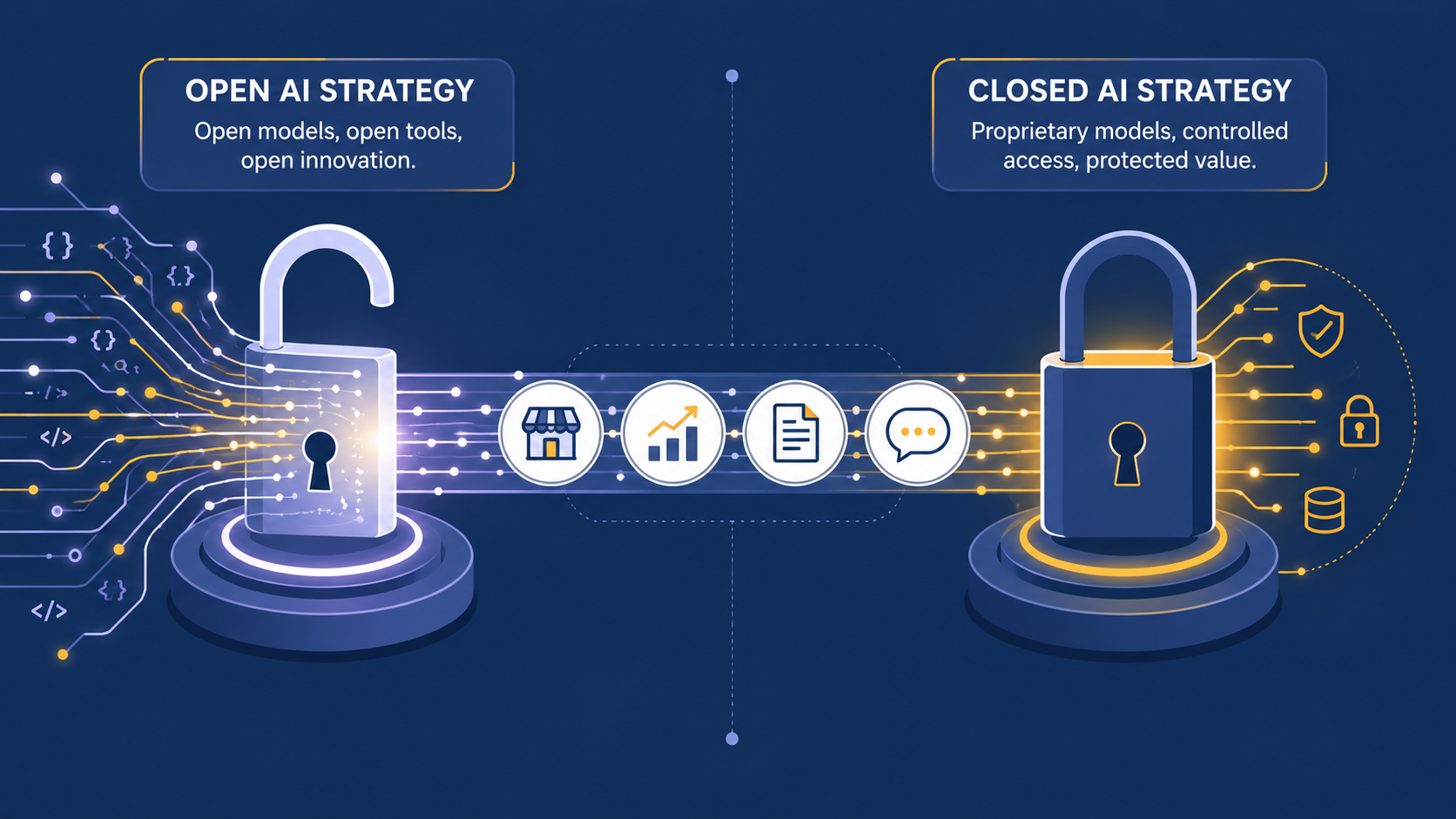
But the story has changed. Two months ago, Meta shipped its first closed-weight proprietary model, Muse Spark. The company that built its AI reputation on openness now runs two parallel strategies: free models for the community, proprietary models for its own products. Understanding what that split means for your business is the point of this post.
What Meta Built and Why the Meta AI Ecosystem Matters
Meta’s Llama model family is the most widely downloaded open-weight AI model in the world. By early 2026, total Llama downloads had crossed 1.2 billion. That’s roughly a million downloads a day. The Llama 4 series arrived on April 5, 2025, and introduced two production-ready models built on a mixture-of-experts architecture.
Scout carries 109 billion total parameters with 17 billion active at any given moment, spread across 16 experts. It fits on a single NVIDIA H100 GPU and offers a 10-million-token context window, which means it can process entire codebases or massive document libraries in a single prompt. I’ve watched developers feed it full legal libraries and get coherent analysis back. Nothing else in the open-weight world does that at this scale.
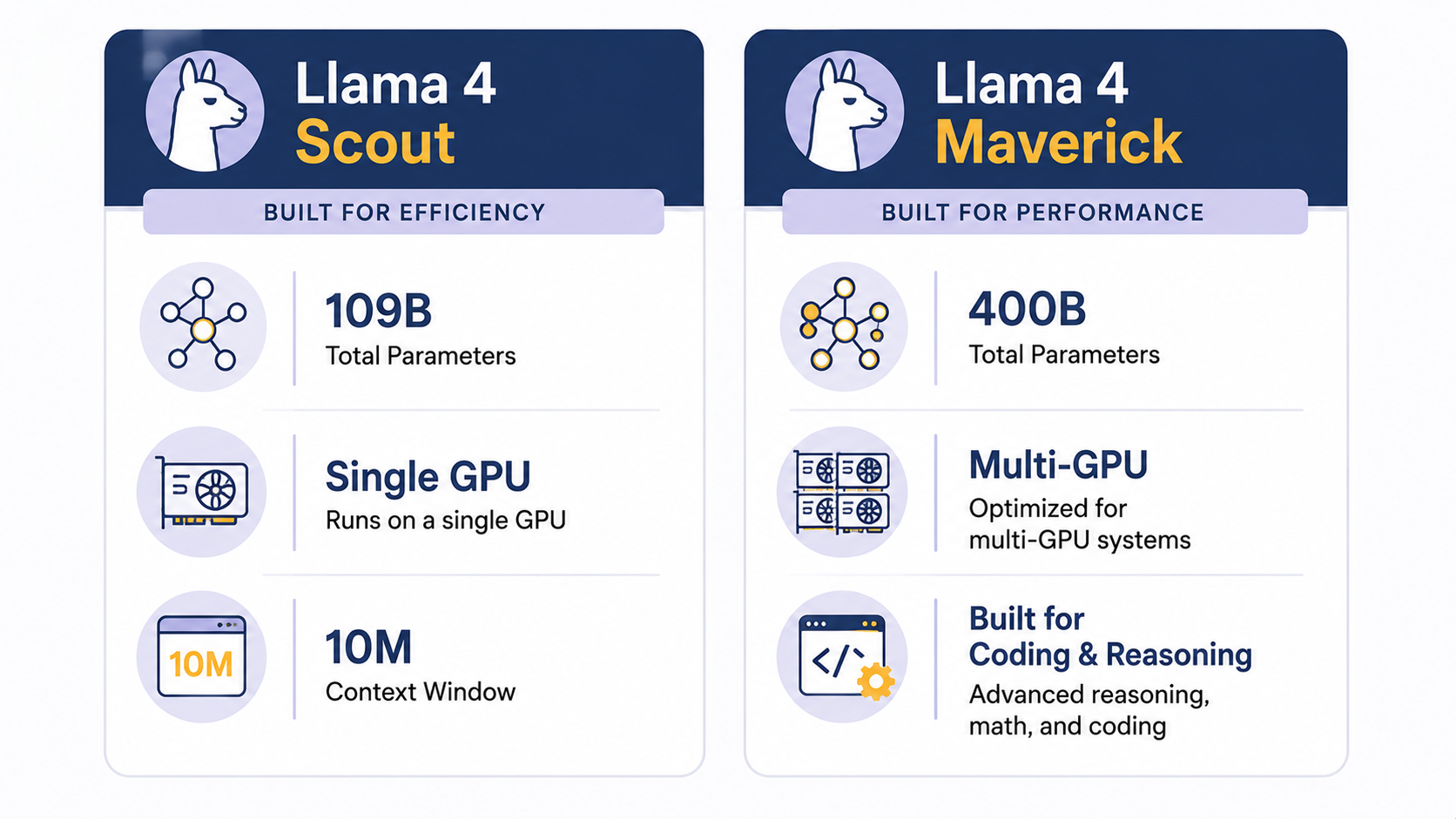
Maverick is the heavier model. Same 17 billion active parameters, but 128 experts and 400 billion total parameters. It handles coding, multimodal reasoning, and complex analysis at a level that competes with GPT-4o and Gemini 2.0 Flash across a broad set of benchmarks. The performance-to-cost ratio is what turned heads when it launched.
Meta didn’t release these models as charity. The open-weight strategy serves concrete business interests. It drives adoption of Meta’s broader ecosystem, reduces the industry’s dependency on competitors’ APIs, attracts top AI talent, and creates a developer community building on Meta’s technology. By making the model layer free, Meta forces competitors to compete on price and distribution rather than model access. That competitive pressure benefits Meta’s advertising and social commerce businesses, which is where the actual revenue comes from.
The economics are fundamentally different from OpenAI, Anthropic, or Google. There are no per-token API fees for running Llama. No monthly subscriptions for model access. The cost is infrastructure: you need hardware to run the models and technical capability to deploy and maintain them.
The Muse Spark Pivot: Meta’s AI Identity Split
Here’s where the story gets complicated and where any clear-eyed look at the Meta AI ecosystem has to reckon with a significant strategic reversal.
Muse Spark is Meta’s first closed-weight model. Meta Superintelligence Labs built it in secret over nine months and shipped it in April 2026. No downloadable weights. No open architecture. No community fine-tuning. The first model Meta has ever refused to give away.
The backstory matters. Llama 4’s reception from the developer community was rocky. Engadget described it as an “icy reception.” Benchmark controversies followed. Meta’s outgoing Chief AI Scientist, Yann LeCun, acknowledged in a Financial Times interview that different models had been used for different testing configurations to boost scores. The credibility damage was real. Mark Zuckerberg responded by creating Meta Superintelligence Labs as a clean-slate rebuild and recruited Alexandr Wang, the former co-founder of Scale AI, to lead it as Meta’s Chief AI Officer.
The result, nine months later, was Muse Spark. It powers the Meta AI assistant across all of Meta’s apps. On the Artificial Analysis Intelligence Index, it ranks fourth behind GPT-5.4, Gemini 3.1 Pro, and Claude Opus 4.6. It’s capable. And it’s locked down.
I’ve talked to a handful of developers who built significant projects on Llama. The reaction to Muse Spark ranged from disappointment to outright anger. One told me, “We picked Meta because they were the open option. Now the best model is closed, and Llama 4 is the terminal open release.” That word, “terminal,” keeps coming up. Llama 4 Scout and Maverick appear to be the last open-weight frontier models Meta plans to release for the foreseeable future.

Meta built its AI credibility on openness. Muse Spark is a bet that proprietary models are now worth more to Meta than community goodwill.
Strengths: What Open Source AI Models Still Offer
Cost Control and Predictability
For businesses processing high volumes of AI queries, the economics of running Llama on your own infrastructure remain compelling. You pay for compute, not per-token fees. That cost is fixed and predictable. One of my clients runs a document analysis pipeline that processes about 15,000 queries a day. On Claude’s API, that was running roughly $4,200 a month. They migrated to Llama 4 Scout on a dedicated cloud instance and brought it down to about $1,100. Same output quality for their use case, a third of the cost.
That math doesn’t work for everyone. But if you have consistent, high-volume AI workloads and someone on staff who can manage deployment, the savings are significant.
Data Sovereignty and Privacy
When you run Llama on your own infrastructure, your data never leaves your environment. No queries go to external APIs. No prompts get used for model training by a third party. For businesses in healthcare, legal, or financial services, this isn’t a nice feature. It’s a compliance requirement. I work with a small accounting firm that handles sensitive client tax data. They can’t send that data to an external AI API without violating their professional obligations. Llama on their own servers is the only path that works.
Customization Depth
Open-weight models can be fine-tuned on your specific business data, terminology, and workflows. A legal firm can train Llama on its own case library. A healthcare provider can fine-tune it on clinical protocols. You can do something similar with closed APIs through prompting and retrieval-augmented generation, but direct model fine-tuning reaches a different level of precision. One of my clients in manufacturing fine-tuned Scout on their proprietary specifications and reduced their internal lookup time from about 12 minutes to under 30 seconds per query. That kind of customization isn’t possible with a general-purpose API.
No Vendor Lock-In
If Meta changes its licensing terms, or a better open model surfaces tomorrow, switching costs are minimal. Your fine-tuned model, your deployment infrastructure, and your integration code all stay yours. I’ve watched three clients eat months of rework because their old platform wouldn’t let data out cleanly. With Llama, that risk disappears. Your investment in customization is portable in a way that proprietary API work never is.
Weaknesses: The Barriers Most SMBs Won’t Clear
Technical Complexity
This is the fundamental barrier separating Meta’s open source AI from the consumer-friendly ecosystems of ChatGPT and Google. Deploying Llama requires choosing infrastructure, configuring model serving, managing scaling, handling security, and maintaining updates. Smaller Llama variants can run on a single GPU, but production deployments for real business applications typically require cloud infrastructure from AWS, Google Cloud, or Azure.
I’ll be direct. Most small businesses under $100M in revenue don’t have the staff for this. A 12-person HVAC company isn’t going to configure Kubernetes to run Llama. A 30-person accounting firm isn’t hiring a machine learning engineer. No amount of enthusiasm about open-weight models changes that reality.
No Standalone Business Product
Meta’s consumer AI assistant lives inside Facebook, Instagram, WhatsApp, and Messenger. It’s not a business productivity tool the way ChatGPT, Claude, or Google Workspace AI are. There’s no “Meta AI for Business” subscription that gives you a chat interface, document analysis, and email drafting in one package. You either access Llama through Meta’s social platforms (limited business utility) or deploy it yourself (high technical bar). You can’t just “sign up for Llama” the way you sign up for ChatGPT. That gap matters.
The EU Ban
This one catches people off guard. The Llama 4 Acceptable Use Policy explicitly bans individuals and companies domiciled in the European Union from using any Llama 4 model. All of them. Not a restriction. Not a delay. A ban. The prohibition is hardcoded into the license, with no carve-outs for research and no exceptions for personal use. Meta made this decision in response to the EU AI Act’s compliance requirements, and it means any EU-based business evaluating Llama 4 needs to look elsewhere. If you have EU operations or EU-domiciled partners, this requires legal review before deployment.
There’s also a commercial licensing threshold. If your organization has more than 700 million monthly active users, you need a separate license from Meta. That threshold won’t affect most SMBs. But if you’re building a product on Llama that scales, it’s a ceiling you should know about before you start.

Support and Accountability
Open-weight models come with community support, not enterprise contracts. If Llama produces incorrect output that affects a business decision, there’s no vendor to call. If a security vulnerability surfaces, the patching timeline depends on community response, not an SLA. I had a client discover a formatting bug in their Llama deployment that was corrupting invoice data. It took their developer three days to diagnose and fix it. With a commercial API, that’s a support ticket with a guaranteed response time.
The Meta Business Agent: Where the Real Action Is for SMBs
If I had to point to the single most important development in the Meta AI ecosystem for small businesses, it wouldn’t be Llama. It wouldn’t be Muse Spark. It would be the Meta Business Agent. Meta took it global in the first week of June 2026.
Meta has been building toward this for over a year. Early in 2026, their AI tools on WhatsApp and Messenger were handling about a million business conversations a week. By the end of Q1, that number had hit 10 million. A tenfold increase in a single quarter.
The Business Agent connects to WhatsApp, Instagram, and Messenger. It handles customer inquiries, recommends products from your catalog, schedules appointments, qualifies sales leads, and completes transactions. Business owners can jump into any conversation at any point. A handoff system lets the AI escalate to a human whenever the conversation crosses a complexity threshold you define.
Over a million businesses were already using it before the global launch. WhatsApp alone has more than 200 million small business users worldwide. Paid messaging revenue on WhatsApp hit a $2 billion annual run rate as of December 2025. These aren’t hypothetical numbers. This is infrastructure that’s already operating at scale.

I’d been watching this space since the source draft for this post early in 2026, when I wrote that the convergence of advertising, social commerce, and AI agents “may prove to be Meta’s most important contribution to the SMB AI landscape.” I underestimated the speed. The Meta Business Agent isn’t a future possibility. It’s live, it’s global, and for SMBs that already advertise on Meta’s platforms and communicate with customers through WhatsApp, it’s the lowest-friction path to AI-powered customer interaction available right now.
No model deployment. No technical staff required. Set it up in minutes, or connect it to your existing Shopify, Zendesk, or Shopee infrastructure if you’re running a larger operation.
The irony is that Meta’s biggest move for small businesses has nothing to do with downloading a model. It’s an AI agent embedded in the messaging apps their customers already use.
Is the Meta AI Ecosystem Right for Your Business?
The answer depends on which part of the ecosystem you’re talking about.
For Llama specifically, I’d tell most SMBs under $100M in revenue that it’s not the right primary AI tool. The technical complexity, the absence of a standalone business product, and the lack of enterprise support make it impractical if you don’t have a developer on staff. Two of my clients tried self-hosted Llama deployments in 2025. One succeeded, but she had a full-time engineer managing it. The other abandoned the project after six weeks and switched to Claude’s API. The cost savings were real on paper, but the operational burden ate the gains.
The exceptions are real, though. If you have in-house developers who need to build custom AI applications, Llama’s economics and flexibility are hard to beat. If you process sensitive data that can’t leave your environment, Llama on your own servers is a genuine privacy-preserving alternative. If you run high-volume, repetitive AI workloads and can handle the deployment, the cost savings justify the effort.
For the Meta Business Agent, the calculus flips. If your business already uses WhatsApp, Instagram, or Messenger to communicate with customers, and especially if you advertise on Meta’s platforms, the Business Agent is worth evaluating immediately. Setup is low-friction. The pricing is consumption-based for WhatsApp Business Platform users or included in certain Meta One subscription tiers. I haven’t seen pricing that would be prohibitive for a small business that’s already spending on Meta ads.
The broader practical recommendation is to benefit from Llama indirectly. Many of the AI tools and platforms you already use are built on Llama under the hood. Cloud providers offer managed Llama deployments that reduce the technical burden. And the competitive pressure Llama creates on pricing benefits every AI user, even if you never touch an open-weight model directly.
What to Watch for the Rest of 2026
Three developments are worth tracking closely.
The dual-track question. Meta now maintains open models (Llama) and a closed frontier model (Muse Spark) simultaneously. Alexandr Wang has said the company “hopes to open-source future versions” of Muse, but gave no timeline. The incentives don’t point toward free weights. Meta’s AI capital expenditure guidance for 2026 sits between $115 billion and $135 billion. That kind of spending creates pressure to protect intellectual property, not give it away. Whether Llama gets a true successor or becomes a maintenance-mode legacy offering is the most consequential open question in the Meta AI ecosystem right now.
The Business Agent expansion. Meta has announced plans to add market research, calendar management, competitive intelligence, and product insight capabilities to the Business Agent. If those features arrive in a form that’s practical for a 15-person company, Meta could become the default AI layer for any small business that lives on WhatsApp and Instagram. I’ll be watching the India, Brazil, and Southeast Asia deployments for early signals. Those markets adopted WhatsApp Business fastest, and they’ll show where the agent adds value and where it falls short.
The Manus fallout. Meta tried to acquire Manus, an autonomous AI agent developer, for over $2 billion late in 2025. China blocked the deal in April 2026. That acquisition was supposed to accelerate Meta’s agent capabilities across its social platforms. Without it, Meta has to build or buy that technology elsewhere. The agent roadmap may take longer than planned.
The Meta AI ecosystem in mid-2026 looks nothing like the story most people tell about it. It’s not just the “open source company.” It’s a company running two strategies at once, betting that open models build the community and closed models build the competitive moat. For small business owners, the piece that matters most isn’t which strategy wins. It’s the AI agent that just showed up inside WhatsApp and started answering your customers’ questions at 2 AM.
That’s the part worth paying attention to.
Good decisions start with good information. Galyx is built for the business owner who knows AI matters and needs a technology partner to guide them through it.
Register at Galyx.com for more insights and guidance.

30+ years of research strategy on projects for Oracle, Cisco, PayPal, and Walmart — now helping small businesses adopt AI that actually delivers.
More about George →