The Google AI Ecosystem: The Full Stack Nobody Else Can Match
Google operates at every layer of the AI stack, from custom chips to consumer apps. Here is what that unmatched breadth means for small business owners choosing AI platforms.
An old friend who is now a CEO told me something last month that stuck. "We use Google for everything. Email, calendar, documents, storage, and video meetings. So when they added AI to all of it, we didn't have to make a decision. It just showed up."
We sat there for a minute with that, and then I asked the obvious follow-up: "But do you know what it's doing? Have you looked under the hood?"
He laughed. "Not even a little."
That conversation captures the Google AI ecosystem in 2026 better than any analyst report I've read. No other company offers anything close to Google's breadth in artificial intelligence. From consumer search to enterprise cloud infrastructure, from frontier models to custom-designed chips, Google operates at every layer of the AI stack simultaneously. They build the chips, train the models, run the cloud, and ship the apps that billions of people already have on their phones and laptops.
That breadth is Google's greatest strength. It's also the reason most business owners I talk to can't tell you what Google's AI can do for them specifically, or where it falls short. So let's sort through that.
The Scope of Google's AI Operation
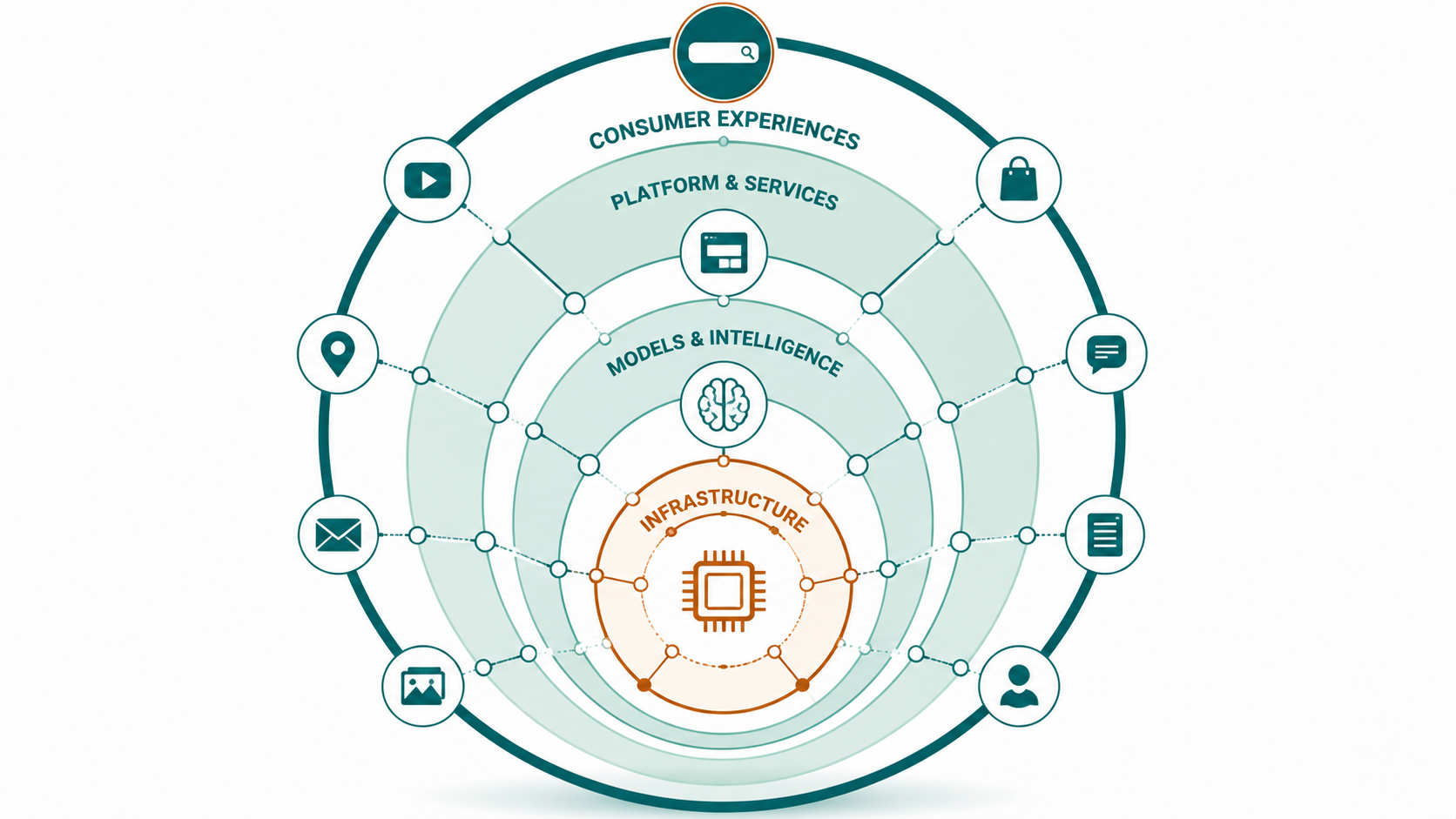
Google's AI ecosystem spans four layers, and each one operates at a scale that would be impressive on its own. Stacked together, they're unmatched.
Start at the bottom: infrastructure. Google designs its own AI chips, called Tensor Processing Units. The latest generation, Ironwood, became generally available in April 2026 at Cloud Next. Each chip delivers 4,614 teraflops of compute, and a single superpod connects 9,216 chips sharing 1.77 petabytes of memory. Compared to its predecessor, Ironwood delivers roughly 10x higher peak performance. Google already has an eighth-generation TPU in the pipeline, split into separate training and inference chips. Anthropic is deploying up to one million of these TPUs to train future Claude models. Meta has negotiated for billions of dollars' worth of chip access. Sit with that for a second. Google is simultaneously competing with and supplying infrastructure to the companies trying to beat it.
One layer up: models. Gemini is Google's frontier AI family. Gemini 3.1 Pro, launched in February 2026, scored 77.1% on the ARC-AGI-2 reasoning benchmark, more than doubling what the previous version achieved. That score put it ahead of both GPT-5.2 and Claude Opus 4.6 on that specific measure. On LMArena's crowdsourced leaderboard, the top three models (Claude Opus 4.6, Gemini 3.1 Pro, and GPT-5.2) sit within a statistical tie. Google also announced Gemini 3.5 Flash at Google I/O in May. Multiple Gemini variants consistently place in the top ten. No other company puts that many models at the frontier simultaneously.
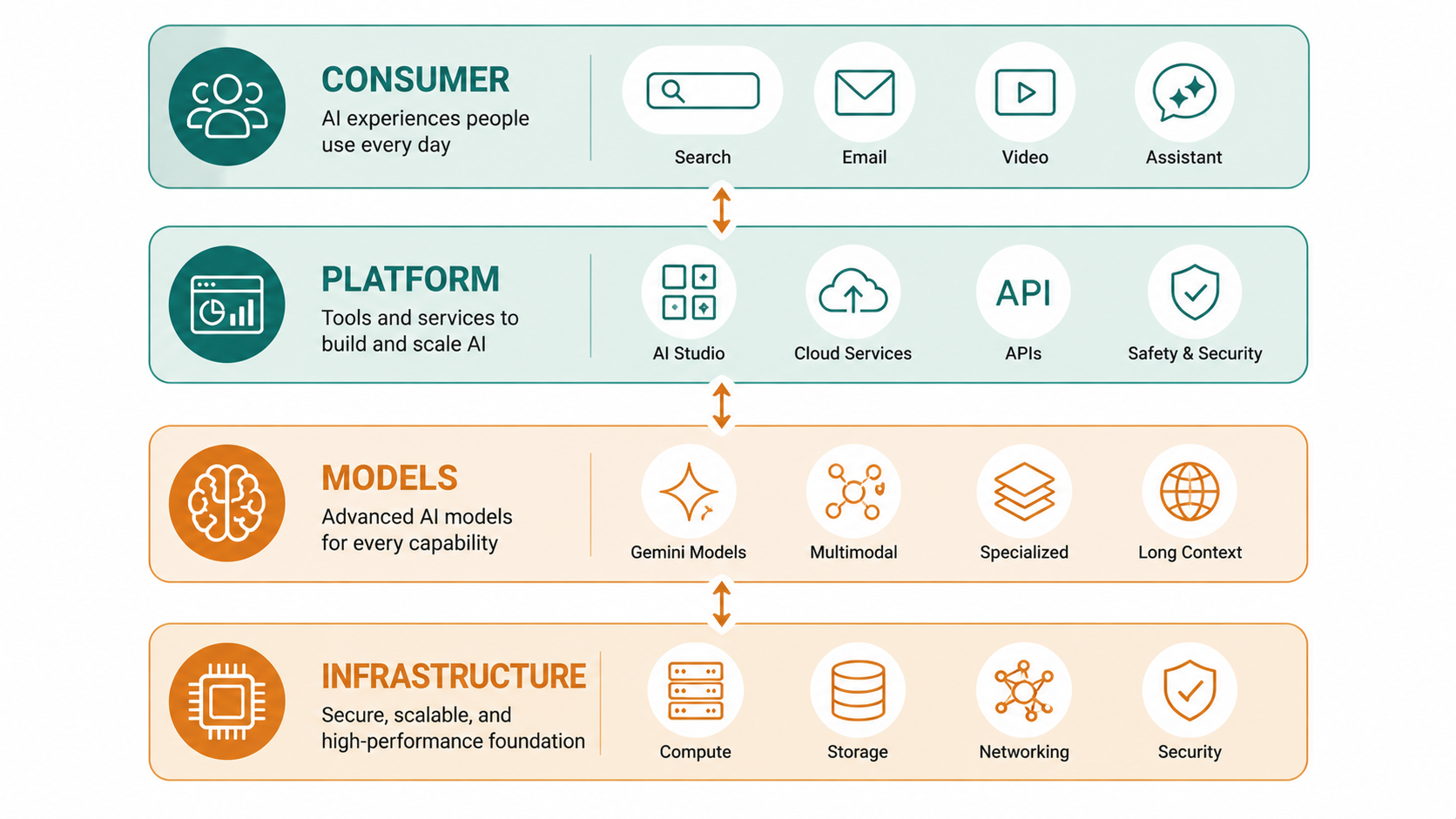
Then there's the platform layer. Google launched Gemini Enterprise in late 2025 as the entry point for business teams. You can build custom agents, pull in company data, run queries across your documents. It connects to Workspace natively, but also plugs into Microsoft 365, Salesforce, and SAP. Eight million paid seats across 2,800 companies within the first few months. I've seen enterprise products launch to silence. This wasn't that.
At the top is the consumer layer. Gemini powers AI Overviews inside Google Search. Two billion people a month see those results. Let that number land for a second.
The Gemini app itself crossed 750 million monthly active users when Alphabet reported Q4 2025 earnings. And those numbers don't include the AI features baked into Gmail, Docs, Sheets, Slides, and Meet. If you use Google products, you're already using Google AI. The question is whether you're using it deliberately or just letting it happen in the background.
Strengths: Where the Google AI Ecosystem Excels

Integration That Already Lives in Your Workflow
If your business runs on Google Workspace, the AI integration is significant, and it's already there. Gemini can draft emails in Gmail, generate presentations in Slides, analyze data in Sheets, summarize meetings in Meet, and search across your entire Drive. These features come included in Business and Enterprise Workspace plans. Google bundled them in starting January 2025, eliminating the old $20-per-user add-on and rolling a $2 increase into the base subscription instead.
Then in April, Google launched something called Workspace Intelligence. The short version: Gemini stops starting from zero every time you ask it something. It reads across your email, your documents, your calendar, your chat threads, and builds a working picture of what you're doing. I've only had a few weeks with it. When it works, the difference is noticeable. When it misses context, you still notice. But the direction is right.
This is the critical difference between Google and standalone AI tools. You don't adopt Google's AI by visiting a new website or downloading a new app. It shows up inside the tools your team already uses. For small business owners with limited IT budgets and no dedicated tech staff, that matters. The biggest barrier to AI adoption isn't cost or capability. It's getting people to change how they work. Google sidesteps that problem entirely for Workspace users.

The Cost Advantage of Owning the Whole Stack
Here's something that doesn't get talked about enough. Google makes its own chips. It runs its own cloud. It builds its own models. And it ships its own applications. That end-to-end ownership means Google can optimize in ways that competitors who rent infrastructure from someone else simply can't.
What does that look like in practice? Lower costs per query, per user, per workflow. When Anthropic or OpenAI run workloads, they're paying a cloud provider for compute. When Google runs workloads, they're paying themselves. That efficiency showed up in Google Cloud's Q1 2026 numbers: $20 billion in quarterly revenue, up 63% year over year, with a $460 billion backlog. It's the same principle that makes a store brand cheaper than the name brand sitting next to it on the shelf. When you own the supply chain, you control the margins.
Commitment to Open Standards
Google contributed its Agent-to-Agent protocol (A2A) to the open standards effort alongside Anthropic's Model Context Protocol (MCP). They've launched enterprise-ready MCP servers that integrate with Google Cloud. Google also maintains one of the broadest partner ecosystems in tech.
Why does that matter for a small business owner? I've watched three clients eat months of rework because their old platform wouldn't let data out cleanly. Open protocols prevent that. If Google goes sideways on you, or if something better comes along next year, A2A and MCP mean you can move your workflows without starting from scratch. That's not a theoretical benefit. That's the thing that keeps you from being stuck.
Weaknesses: The Complexity Problem
Product Naming and Feature Confusion
Google's AI product naming is, and I'm trying to be charitable here, a mess. You've got Gemini (the consumer app), Gemini for Google Workspace (embedded features), Gemini Enterprise (the standalone business platform), Vertex AI (the developer platform), Workspace Intelligence (the new semantic layer), NotebookLM, and now a growing collection of pre-built agents. Understanding which product does what at which price requires more research than most small business owners have patience for.
Compare that to ChatGPT, where you pick Free, Plus, or Team and you're done. Or Claude, which has a clean consumer and enterprise split. Google's packaging creates friction right at the moment when a business owner is trying to make a purchasing decision. Friction at that moment is a deal-killer for a lot of people.

The Workspace Dependency Problem
Here's the thing nobody at Google will say out loud: the best version of Google's AI only shows up if you're already a Google Workspace customer. If your business runs on Microsoft 365, you can sign up for Gemini Enterprise and connect it to your Microsoft apps. It works. But the experience is noticeably thinner than what Workspace users get, especially now that Workspace Intelligence ties Gemini to your entire Workspace footprint by default.
That puts small businesses in an awkward spot. If you've been running your business on Outlook, Word, Excel, and Teams for the last decade, switching to Google Workspace just for AI features is a huge ask. You're talking about migrating email archives, retraining your team on new tools, rebuilding document templates, and hoping nothing breaks in the process. I've watched companies go through productivity suite migrations. "Painful" doesn't cover it. For most businesses already committed to Microsoft, the AI benefit does not justify that disruption. Not even close.
Playing Catch-Up in the Enterprise API Market
This one surprises people, but the data tells the story. Despite Google's technical advantages, when developers choose AI models for custom applications through APIs, Google trails both Anthropic and OpenAI in market share. The LMArena leaderboard shows the models are in a statistical tie at the top, but developer preference and ecosystem loyalty still favor Claude for coding and GPT for broad enterprise deployment. Google's strength is in embedded AI: Search, Workspace, and Cloud. The standalone model API market is where Claude and GPT have built strong footholds.
For the average small business owner, this is mostly an academic distinction. You're probably not building custom AI applications through APIs. But if you work with a developer or consultant who builds tools for your business, it's worth knowing that Google's models aren't their first choice right now. That could change. Google's models are strong and improving fast. But the developer community has favorites, and Google isn't one of them at the moment.
The Pricing Simplification That Isn't Simple Yet
Google has been trying to clean up its AI pricing, and the trajectory is toward simplification. The base Gemini AI features (email drafting, document assistance, data analysis, meeting summaries) now come bundled with Workspace at no extra charge. That's genuine progress from the old model where you needed a separate $20 add-on.
But here's where it gets complicated again. Google still offers an AI Expanded Access add-on for teams that need higher usage limits and advanced features like AI video generation. There was also an AI Ultra Access tier, but Google announced it's being discontinued as of July 2026. That kind of churn in packaging, where a premium tier launches and gets killed within a year, makes it hard for budget-conscious small businesses to commit. You don't want to build workflows around a tier that might not exist next quarter.
My advice: start with what's already included in your Workspace plan. Most of the small businesses I work with don't need the add-on. The bundled tier handles their email drafts, meeting notes, and spreadsheet formulas. One client ran Expanded Access for two months and dropped it. The base tier was doing the job. If you're consistently hitting limits on the features you actually use every day, then explore the upgrade. Not before.
Is the Google AI Ecosystem Right for SMBs?
For businesses already running on Google Workspace, the answer is a clear yes for the standard AI features. The integration is genuine, the quality is competitive, and the marginal cost is effectively zero for the capabilities most teams need day to day. Gmail summaries, Docs writing assistance, Sheets analysis, Meet transcription. These deliver immediate, measurable time savings with no new software to learn.

For businesses not on Google Workspace, the picture gets muddier. Take away the Workspace connection, and what's left? A capable chatbot competing against ChatGPT, Claude, and Copilot without the integration advantage that makes Google's version different. Gemini Enterprise can stand on its own, but it's fighting on open ground where the other three have dug in.
Google's AI ecosystem is the deepest and broadest in the industry. The challenge for business owners is not whether Google has the capabilities they need. It's whether they can find them.
If you use Google Workspace, turn on the AI features today. They're sitting there. You're paying for them. If your team starts running into limits, pilot the Expanded Access add-on for your highest-volume team and track whether the time savings justify the cost. Give it 60 days.
If you're on Microsoft 365, I'd tell you to look at Gemini Enterprise on its own merits, but I wouldn't tell you to switch productivity suites for AI alone. I've watched that migration play out with clients. The switching costs eat the AI gains for at least a year. And the AI landscape is moving too fast to lock yourself into a platform bet that might look completely different by next spring.
What to Watch for the Rest of 2026
Google's position in the AI race will be shaped by a few things in the coming months. Workspace Intelligence is rolling out to customers now, and whether it delivers on the promise of context-aware AI, not just prompt-and-response AI, will determine how sticky Google's ecosystem becomes for business teams. The Gemini 3.5 family announced at Google I/O in May introduces new capabilities around multimodal reasoning and agentic work. If those models land well, Google's competitive position strengthens considerably.
The enterprise adoption numbers tell a compelling story. Over 8 million Gemini Enterprise paid seats. 2,800 companies. Names like HCA Healthcare, Best Buy, Kroger, Lowe's, Deloitte, and Deutsche Telekom. Scaling beyond early adopters will require Google to keep simplifying its packaging. Business buyers need to be able to navigate the options without hiring a consultant to explain them.
And then there's the structural advantage that doesn't go away regardless of which model is on top this month. Google's dual role as competitor and infrastructure provider creates a dynamic unlike anything else in tech. As long as Anthropic trains on Google TPUs and runs on Google Cloud, Google profits even when its own models don't win a deal. That economic resilience sets Google apart. They get paid whether they win or lose.
That's not a bad place to be.
Good decisions start with good information. Galyx™ is built for the business owner who knows AI matters and needs a technology partner to guide them through it.
Register at Galyx.com for more insights and guidance.

30+ years of research strategy on projects for Oracle, Cisco, PayPal, and Walmart — now helping small businesses adopt AI that actually delivers.
More about George →