The AI Ecosystem Map: How Major Platforms Work Together and Apart
Five AI ecosystems dominate 2026. Learn how OpenAI, Anthropic, Google, Meta, and Microsoft compete, converge, and what it means for your business.
There’s a conversation happening in AI right now that most business owners aren’t part of. Not because they don’t care. Not because they can’t follow the technical details. They’re not part of it because the conversation is happening at the infrastructure level, inside protocol committees and open-source governance bodies and foundation model boardrooms, and nobody is bothering to translate it into language that matters for the people who’ll feel the consequences most.
That conversation is about ecosystems. Not individual tools. Not which chatbot gives better answers on a Tuesday afternoon. The real question shaping the next decade of business technology is simpler and bigger than that: who controls the platforms, how do they connect, and what happens to your business when the ground shifts underneath the tools you depend on?
I’ve been mapping this territory for months. Partly for my own understanding, partly because clients keep asking me the same question in different words: “Should I be worried I’m building on the wrong platform?”
Depends on what you know about the landscape. So let’s build that knowledge together. Not a feature comparison chart (those go stale within weeks), but a structural overview of how these AI ecosystems for business operate, compete, and in some surprising cases, actively help each other.
The Five AI Ecosystems That Matter Right Now
As of mid-2026, five major ecosystems dominate the AI landscape. Each is anchored by a foundation model and surrounded by an expanding constellation of tools, platforms, and integrations. They’re not interchangeable. Each has a center of gravity that pulls users toward a particular way of working, and understanding those gravitational forces is what separates a good AI investment from a frustrating one.
OpenAI: The Consumer Gateway
OpenAI is still the name most people think of when they hear “AI.” And the numbers explain why. ChatGPT hit 900 million people using it every week by February 2026. By May, it crossed one billion monthly active app users, according to Sensor Tower estimates that Reuters picked up in June. That makes it the fastest app in history to reach that milestone. Faster than TikTok, faster than Instagram, faster than Google Maps.
The ecosystem centers on ChatGPT as the primary interface. GPT models power everything from the consumer chat product to enterprise APIs to the Codex coding agents. OpenAI wants to be the front door, the first place you go when you think “I need AI for this.” The integration of apps, plugins, and custom GPTs inside ChatGPT creates a self-contained world where you can search the web, analyze data, generate images with DALL-E, and interact with third-party services without ever leaving the chat window.
The revenue growth is staggering. OpenAI’s CFO Sarah Friar confirmed the company crossed $20 billion in annualized revenue for 2025. By March 2026, Reuters reported that number had jumped past $25 billion, roughly $2 billion every month. On March 31, SoftBank co-led a $122 billion funding round that valued the company at $852 billion. Then, on June 8, OpenAI filed a confidential S-1 with the SEC. Two days ago. The formal path to what could become one of the largest IPOs ever recorded just started.
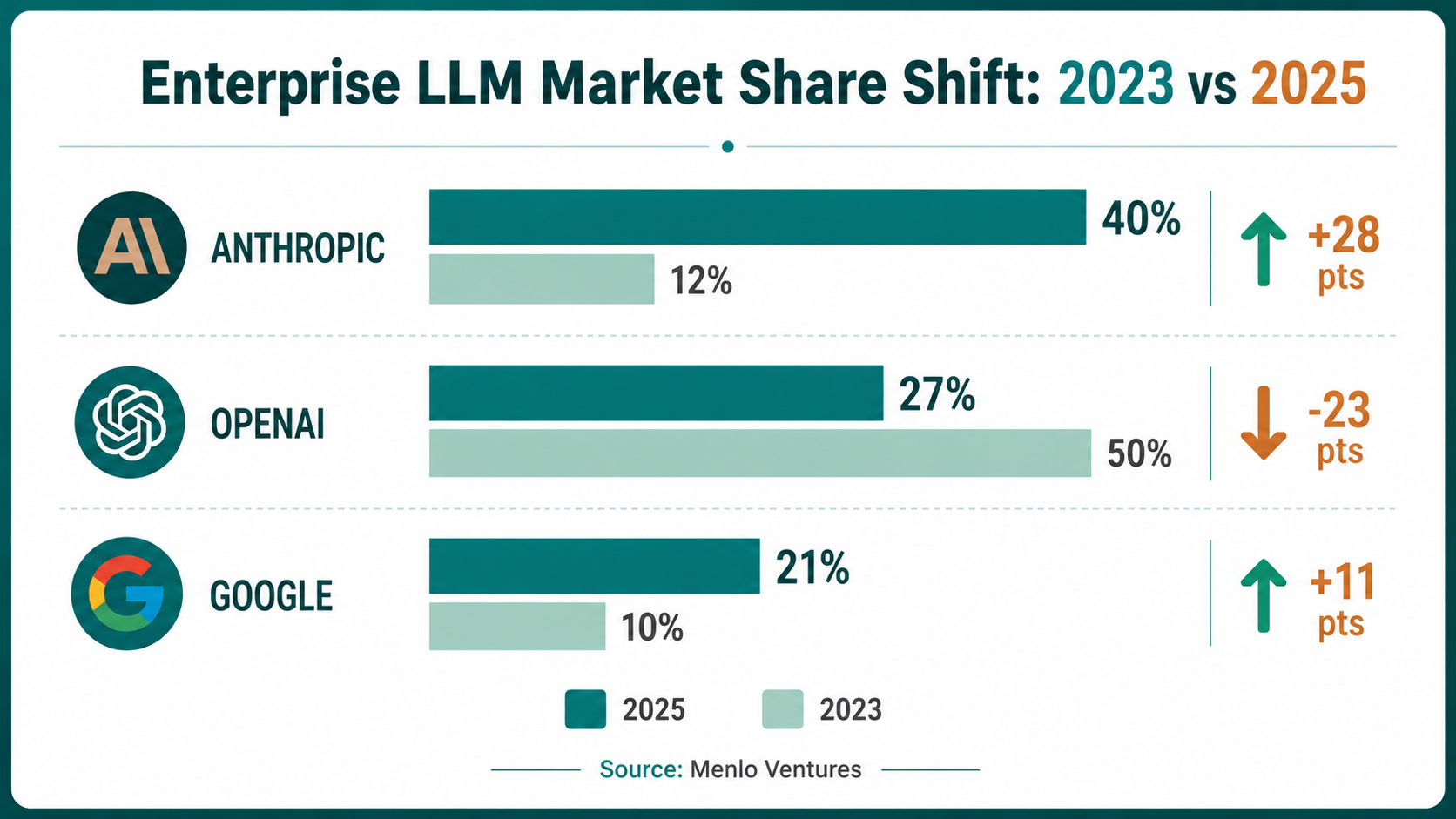
But here’s where it gets complicated. OpenAI’s grip on the enterprise market is loosening, and the data is hard to argue with. Menlo Ventures has been tracking this shift since 2023, when OpenAI controlled half of all enterprise LLM spending. Half. Two years later, that number sits at 27%. And it’s not just enterprise buyers moving. Apptopia reported in May that ChatGPT’s U.S. mobile app share dropped below 40% for the first time. Consumers still love it. The people writing the checks? They’re shopping around.
There’s a cautionary story here too. OpenAI killed Sora, its AI video product, in March 2026. I followed this one closely. Forbes and Appfigures reported that Sora was burning roughly $15 million a day in inference costs while generating $2.1 million in total lifetime revenue. Total. Not per day. The $1 billion Disney licensing partnership that was supposed to anchor the business fell apart alongside it. Even the most well-funded AI company in history can’t sustain every product line. That’s worth remembering when you’re betting your business processes on a specific tool.
Anthropic: The Enterprise and Developer Favorite
I’ve been watching Anthropic for a while now, and what happened with their revenue in 2026 caught even me off guard. At the end of 2025, their annualized run-rate sat at about $9 billion. Two months later it had nearly doubled to $14 billion. Then it went vertical. April: $30 billion. May: $47 billion. VentureBeat covered it. Simon Willison charted it. Dario Amodei, their CEO, told reporters the growth outstripped their own internal forecasts by a factor of eight. I don’t think I’ve ever seen a revenue curve like that in enterprise software.
The Menlo Ventures report from December 2025 put Anthropic at 40% of enterprise LLM API market share, up from 12% two years earlier. OpenAI went from 50% to 27% over that same period. Claude Code, their developer tool, is a big part of why. Developers I talk to treat it the way an earlier generation treated Stack Overflow, as something they open every morning and close when they’re done for the day. By February 2026 it was pulling in $2.5 billion in run-rate revenue on its own.

Anthropic raised a $30 billion Series G at a $380 billion valuation in February. Reuters reported in April that the company was weighing a new round above $900 billion. And on June 1, Anthropic filed its own confidential S-1 for an IPO. Think about that for a second. Two companies worth a combined $1.8 trillion, both preparing to go public in the same week. That’s the kind of moment that marks a turning point.
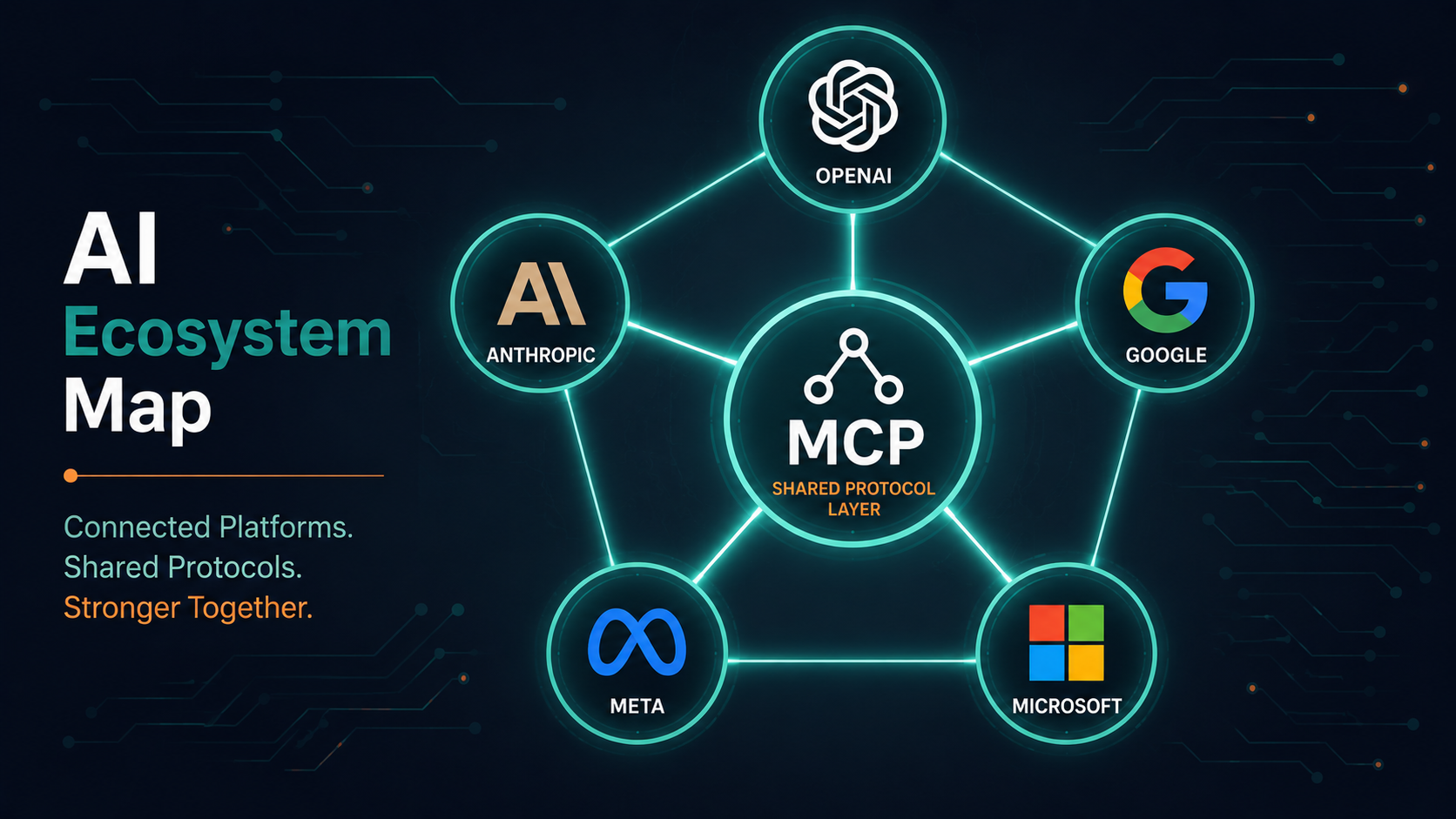
But the thing from Anthropic that might matter most for your business isn’t a model. It’s the Model Context Protocol, or MCP. Think of it as a universal adapter that lets AI models connect to external tools, databases, and APIs in a standardized way. Anthropic built it, then gave it away to the Linux Foundation’s Agentic AI Foundation. By making MCP an open standard instead of keeping it proprietary, Anthropic positioned itself as the connective tissue of the whole AI agent economy. OpenAI adopted it. Google adopted it. Microsoft adopted it. As of December 2025, there were over 10,000 active public MCP servers and the SDK was being downloaded 97 million times a month across Python and TypeScript. People call it the “USB-C for AI.” That comparison holds up.
One more thing worth knowing. Claude is now available across all three major cloud platforms: AWS Bedrock, Google Cloud Vertex AI, and Microsoft Azure Foundry. No other frontier model can say that. If OpenAI owns the consumer front door, Anthropic is building the plumbing that connects everything behind it.
Google: The Full-Stack AI Ecosystem
Google’s AI ecosystem is the broadest and deepest, and that’s both its greatest strength and its biggest source of confusion for people trying to understand it. Gemini models power consumer search, the Gemini app, Google Workspace integrations, the Vertex AI developer platform, and the cloud infrastructure that other AI companies rent. The Gemini app alone had 750 million monthly active users by early 2026. Analysts at Tech Insider predicted it would pass one billion by Q3.
What makes Google different from everyone else on this list is vertical integration. They design their own AI chips. At Google I/O 2026 in May, they unveiled the eighth generation: TPU 8t for training, TPU 8i for inference. They run their own cloud. They build their own models. They distribute through products that billions of people already use every day. And here’s the part that makes the competitive dynamics genuinely strange: Anthropic buys Google’s TPUs. Meta has negotiated for Google TPU access. Google is selling picks and shovels to the people mining the same gold.
It gets even more intertwined. Reuters reported in April 2026 that Google is investing up to $40 billion in Anthropic, while simultaneously hosting Claude models on Vertex AI and competing against Claude with Gemini. At I/O 2026, Sundar Pichai called this the beginning of the “agentic Gemini era,” where AI doesn’t just answer questions but acts as a supervised assistant that can plan, reason, and take action across Google’s product suite. Google also contributed its Agent-to-Agent protocol to the open standards effort and launched enterprise MCP servers.
The ecosystem stretches from consumer products (Search, Gmail, Docs) through developer tools (Vertex AI, Gemini API) to raw infrastructure (TPUs, Cloud). That’s a stack no single competitor can match.

Meta: The Open-Source Engine
Meta plays a different game entirely. Their Llama models are open-weight. Anyone can download them, modify them, and deploy them without paying Meta a licensing fee. Llama is the most widely used open-weight model in enterprise environments, and Meta has made it clear that giving the models away for free isn’t generosity. It’s strategy. Free models drive adoption of Meta’s broader ecosystem, reduce everyone’s dependency on competitors’ APIs, and build a massive developer community around Meta’s technology.
Meta’s AI work is also deeply tied to its advertising and social media business. They’re building AI agents inside WhatsApp and Messenger to handle sales and customer service for businesses that advertise on Meta’s platforms. The ambition is clear. Late in 2025, Meta tried to buy a company called Manus for roughly $2 billion. Manus builds AI agents that can operate independently. The deal would have given Meta a serious head start in autonomous agent technology. But China’s National Development and Reform Commission blocked it on April 28, 2026, and ordered the parties to unwind the whole transaction. By then, Manus employees had already joined Meta’s AI team and investors had already been paid. Bloomberg reported the Manus model was “officially dead.” The episode became one of those stories that reveals just how tangled the geopolitics of AI have become.
For businesses evaluating their options, Meta’s pitch is simple. If you want to run AI on your own servers, customize models for your exact use case, and avoid per-token API charges, Llama is where you start.
Microsoft: The Integration Play
Microsoft isn’t really in the frontier model race. They’re in the distribution race, and they’re winning it by a wide margin. Copilot is woven into Microsoft 365, Dynamics, GitHub, Azure, and Teams. The partnership with OpenAI gives Microsoft access to GPT models, but they’ve also built their own smaller models and spread their bets across multiple AI partnerships.
What Microsoft has that nobody else does is a billion people already using their products every day. When AI shows up inside Word, Excel, Outlook, and Teams, you don’t have to convince anyone to try it. It’s just there. Adoption isn’t a marketing problem; it’s an upgrade cycle. Azure also runs as the cloud backbone for OpenAI’s API, which means Microsoft takes a cut of OpenAI’s growth while simultaneously building competing products on the same infrastructure. (I’ve explained this to clients multiple times and it still feels like a business relationship that shouldn’t be possible.)
Microsoft is a founding platinum member of the Agentic AI Foundation, committed to the same interoperability standards as its competitors. Pragmatic move. Enterprise buyers won’t accept tools that only work inside one vendor’s walled garden, and Microsoft knows this from decades of experience.
The biggest rivals in AI just co-founded an organization to make their products interoperable. That’s not altruism. It’s a bet that the market will be bigger if systems work together.

Where the AI Ecosystems Converge
Here’s what surprises most people when I walk them through this: these competitors are actively building shared infrastructure together.
In December 2025, OpenAI, Anthropic, Block, Google, Microsoft, Amazon Web Services, Bloomberg, and Cloudflare co-founded the Agentic AI Foundation under the Linux Foundation. The whole point is creating open standards so AI agents built by different companies can work together. Three projects anchor the effort. Anthropic’s MCP handles how agents connect to tools. OpenAI’s AGENTS.md (adopted by over 60,000 open-source projects) gives coding agents standardized project instructions. Block’s Goose is an open-source agent framework that runs locally on one machine.
MCP alone tells you everything about where this is heading. Over 10,000 public servers. The SDK downloaded 97 million times a month. When OpenAI plugged MCP into ChatGPT’s apps feature, that was the moment it stopped being Anthropic’s protocol and became the industry’s protocol. A developer building an AI workflow can now, in theory, swap between Claude, GPT, and Gemini models while keeping the same tool connections. The models compete on quality and cost. The plumbing underneath is shared.
The convergence runs even deeper at the hardware level. The era of Nvidia exclusivity is ending. Anthropic runs on Amazon’s Trainium chips and is buying Google’s TPUs. OpenAI is using Google TPUs and has been talking to Amazon. Meta negotiated Google TPU access. The chip supply chain is going multi-vendor, which is good for everyone building on top of it because it reduces bottlenecks and, eventually, costs.
Where the AI Ecosystems Diverge
Shared protocols don’t mean shared philosophies. The differences between these ecosystems are real and they’ll shape how AI develops for years.
The open versus closed divide is the most fundamental split. OpenAI, Anthropic, and Google keep their best model weights locked down. Meta publishes theirs. DeepSeek and a growing wave of Chinese labs have gone all-in on open-weight releases, and the performance gap between open and closed frontier models keeps shrinking. Months to weeks now. This tension decides who can customize AI at the deepest level and who depends on someone else’s API for everything.
Safety approaches differ sharply too, and this isn’t just philosophical window dressing. Anthropic classifies models under an AI Safety Levels framework and runs Claude in sandboxed environments. OpenAI builds modal safety systems with automatic pauses into agent products. Google uses cloud-based virtual machines that wall off agent actions from user data. These choices determine how much autonomy AI agents get and, frankly, how much risk you absorb as a user.
Then there are the business models, which I think deserve more attention than they’re getting. OpenAI started running ads inside ChatGPT in January 2026. They enrolled over 600 advertisers, and the pilot crossed $100 million in annualized revenue within six weeks. Their internal projections for full-year 2026 reportedly target $2.4 billion in ad revenue. Meanwhile, Anthropic charges per API call. Google folds AI into existing subscription bundles. Meta gives the models away entirely and makes money through advertising on its social platforms. Microsoft charges per-seat Copilot licenses. These aren’t just different pricing structures. They’re different incentive systems. When the tool you rely on is optimized for your engagement rather than your accuracy, that’s a distinction worth understanding.

A Framework for Choosing AI Ecosystem Platforms
All of this complexity can feel paralyzing. But the decision framework is simpler than it looks once you strip away the noise.
Use more than one ecosystem. The single-vendor era is already over for most serious users. A developer I work with writes code with Claude, prototypes interfaces with ChatGPT, runs production workloads on Llama from her own servers, and uses Gemini for research through Google’s search integration. A manufacturing client uses Copilot in Office, Claude’s API for customer-facing applications, and Meta’s open models for internal automation. That’s not fragmentation. That’s specialization.
Pay attention to the connective layer. MCP and the Agentic AI Foundation are making AI interoperability better, fast. If a tool embraces open standards, it gives you flexibility to move. If it locks you into proprietary connections, be cautious. Doesn’t matter how polished it looks today.
Match the ecosystem to the task you’re solving, not to the brand you recognize. OpenAI is strongest in consumer accessibility. Anthropic dominates coding and enterprise API work. Google has the broadest integrated stack by a wide margin. Meta gives you the most flexibility if you want to run models on your own infrastructure. Microsoft makes AI invisible inside the office tools your team already uses. No single platform wins across the board. The right answer changes depending on the problem.
Watch the economics. This one keeps me up at night. Both OpenAI and Anthropic are heading for public markets now, and that means the subsidized pricing structures we’ve gotten used to will face real pressure from investors expecting profitability. OpenAI alone is projected to burn through roughly $27 billion in 2026. Building critical business processes on a platform whose pricing might shift dramatically within a year is a risk that most people aren’t thinking about carefully enough.
There’s no single best AI platform. There’s only the best platform for a specific problem. Understanding the map is what makes that choice possible.
The Bigger Picture for Business AI Ecosystems
What we’re watching isn’t just a technology competition. It’s the formation of the infrastructure that will shape how work, communication, and commerce function for the next decade. I keep coming back to the internet parallel. In the 1990s, you had competing browsers, competing protocols, competing visions for what the web should be. The companies that won that era weren’t necessarily the ones with the best technology. They were the ones that built useful platforms on top of open standards that let everything connect.
Same dynamic, playing out again. The AI companies that will matter most in five years are the ones building on open protocols, integrating deeply into the workflows people already depend on, and earning trust through transparency about what their systems can and can’t do. The walled gardens will have their moment. And then something better will come along that plays well with everyone else, and the walls won’t matter.
This is a moment that rewards paying attention. Not to every model release and benchmark score, but to the structural forces underneath: who controls the infrastructure, where standards are forming, and which ecosystems are designed to work with the world instead of trying to capture it.
The map is getting clearer every month. Understanding it is the starting point.
Good decisions start with good information. Galyx™ is built for the business owner who knows AI matters and needs a technology partner to guide them through it.
Register at Galyx.com for more insights and guidance.

30+ years of research strategy on projects for Oracle, Cisco, PayPal, and Walmart — now helping small businesses adopt AI that actually delivers.
More about George →