AI-Powered Customer Service: How Small Businesses Are Turning Support Into a Revenue Engine
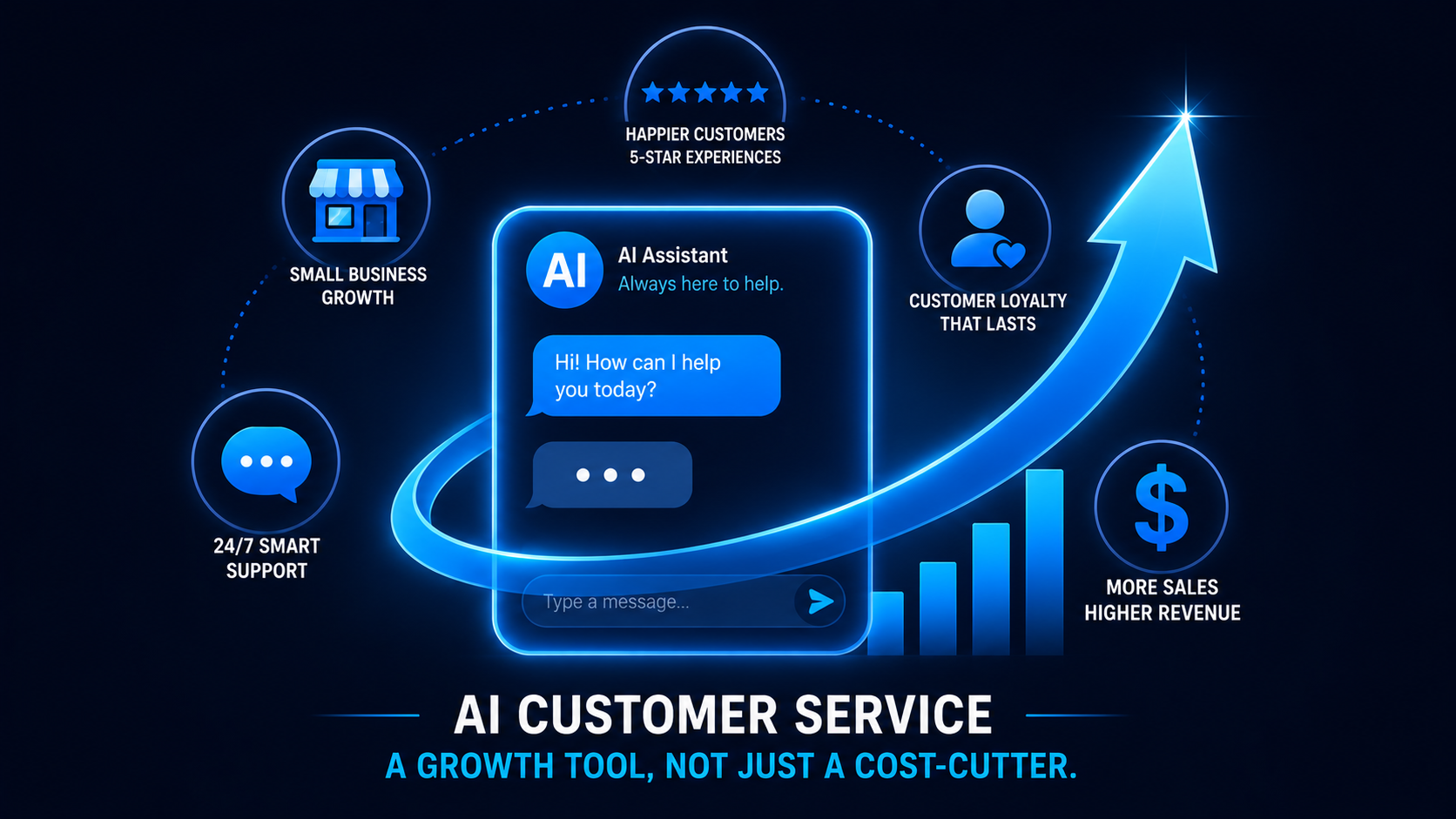
AI customer service tools are helping SMBs cut support costs, retain more customers, and grow revenue. Here's what's working and how to start this week.
Before I spend a dollar on any new tool, I run it through the same three questions. They haven't failed me yet. Does it solve a real problem I have right now? Can I see results within 90 days? And does it make my team better at the work that matters, or just busier in a different way?
I've been running those questions on AI customer service tools for the past year. Sitting with the data. Watching what actually happens at businesses my clients run. And I want to give you an honest read on it, because the conversation happening around this topic is a mess. Half the content out there treats AI customer service like a magic cost-eraser. The other half acts like you need an enterprise IT team to make it work. The truth sits somewhere in the middle, and it's more interesting than either extreme.
Here is what I can tell you: the businesses growing fastest right now are not doing it by hiring more support staff. They're building customer service operations that work around the clock, catch problems before they escalate, and turn support conversations into selling opportunities. AI is a big part of how they're doing that.
But the number that stopped me when I first dug into this research wasn't about cost savings. It was about what's already happening at businesses your size. According to a 2025 Talkdesk survey of U.S. small business owners, 51% of small businesses have already integrated AI into their customer service operations. That's not a projection. That's today.
Let me walk you through what's working, where it falls apart, and what to do about it this week.
The Revenue Connection Most Small Business Owners Miss
There's a belief baked into how most small businesses think about customer support: it's a cost center. You staff it because you have to. You try to keep it lean. You measure it by how much it costs per ticket resolved.
That framing is outdated, and AI is one of the reasons why.
A BCG study caught my attention when I was pulling research for this post. They surveyed 1,000 C-suite executives across more than 20 sectors, and the finding that stood out: support functions account for 38% of the total business value companies are getting from AI. Not operations. Not sales and marketing. Support.
Think about what that means if you're running a team of 8 or 15 or 30. You don't have the budget for a three-shift support operation. But an AI system doesn't call in sick, doesn't get frustrated at 10 PM on a Saturday, and costs roughly $0.50 per interaction compared to around $6.00 for a human agent. That's a 12x cost difference, confirmed across multiple industry sources including Juniper Research.
The businesses growing fastest aren't just cutting costs with AI customer service. They're turning support into a revenue channel.
I talked to a friend who runs a mid-size e-commerce operation selling specialty outdoor gear. She added an AI chatbot about eight months ago. Within the first quarter, her team saw a 20% bump in customer retention. Repeat orders climbed. Average order value went up because the bot was trained to make relevant product suggestions during support conversations.
Her exact words: "I thought I was buying a cost savings tool. Turns out I bought a sales rep that works 24/7."
(I've heard variations of that line more times than I can count over the past year. It keeps being true.)

What AI-Powered Customer Service Actually Looks Like in 2026
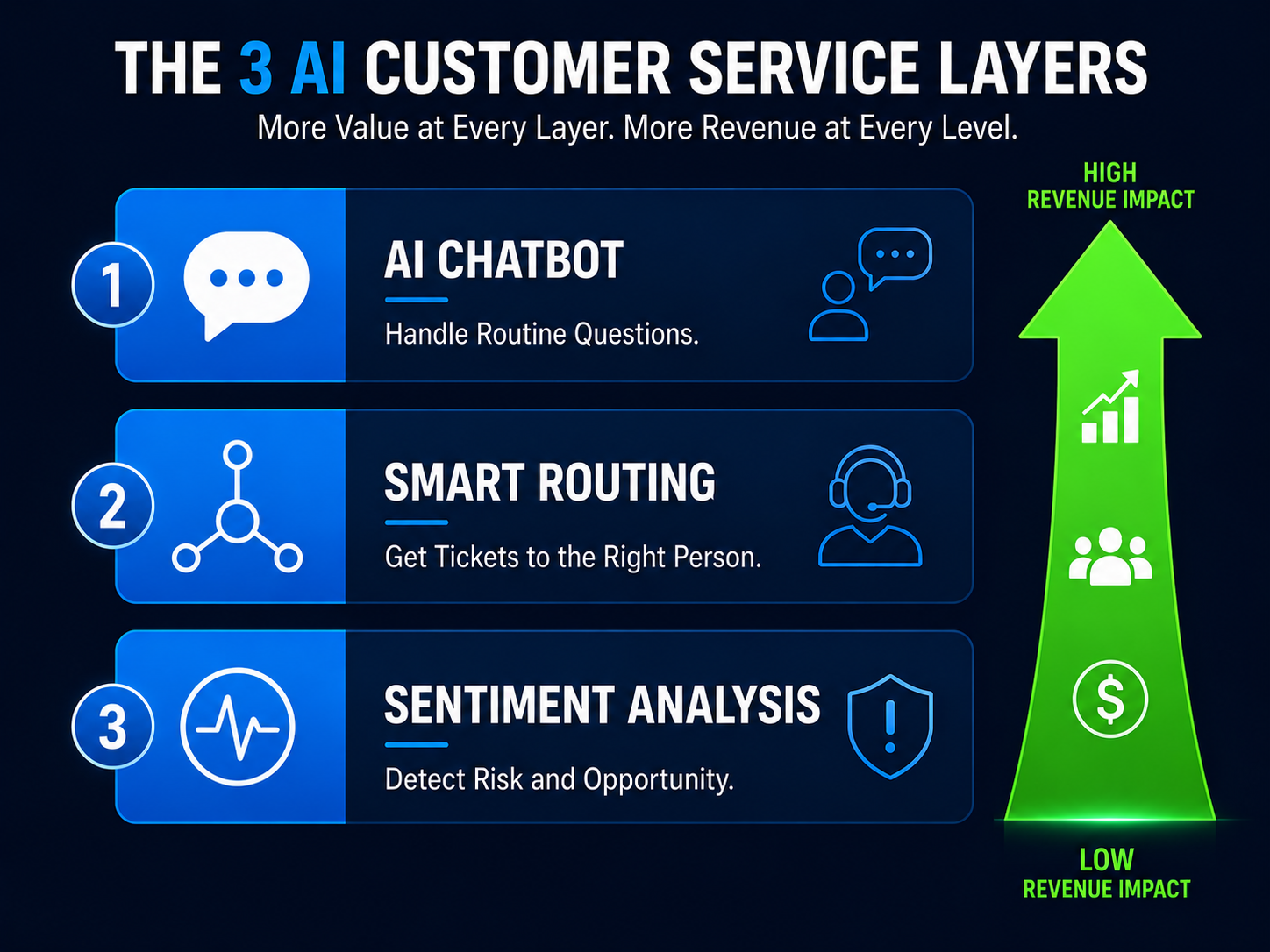
"AI customer service" can mean a dozen different things, and most of the marketing around it sounds more impressive than the reality. Let me break down the three categories worth your attention if you're running a small business.
AI Chatbots That Handle the Routine Volume
This is where most businesses should start. Modern AI chatbots built on large language models are genuinely different from the clunky rule-based bots from five years ago. They understand context. They remember what someone said two messages ago. They can respond in natural language that doesn't make customers want to throw their phones.
The practical target is your top 20 most common questions. Order status, return policies, business hours, pricing, appointment scheduling. For most small businesses, those inquiries eat up 40 to 60% of incoming support volume. Automate that chunk and your human team suddenly has time for the conversations that need real judgment.
On pricing: this category moves fast and vendors change tiers frequently. Tidio, which is purpose-built for smaller teams, typically runs $29 to $79 per month for its base plans with AI add-ons on top of that. Intercom's Fin is more capable on complex conversations but bills at $0.99 per resolution, which adds up quickly at volume. Zendesk works well if you already have a support team of 10 or more. Before you commit to anything, run the actual numbers on your expected volume and check pricing directly with the vendor.
Smart Ticket Routing and Triage
Less flashy, but often where the ROI shows up fastest. AI tools can now read an incoming support request, categorize it, assess urgency, and route it to the right person on your team before anyone touches it. A billing issue goes to your office manager. A technical problem goes to whoever handles that. A flagged VIP account gets escalated before it gets cold.
The result is fewer tickets sitting in the wrong inbox for three days. Faster resolution. Your best people spending energy on the problems that need them most.

Sentiment Analysis and Proactive Outreach
This is where the revenue piece gets interesting. AI can now analyze the language and tone of customer interactions in real time. It flags when someone is frustrated before they cancel. It spots buying signals during a support conversation. It identifies patterns across hundreds of tickets that no human would catch by reading them one at a time.
A landscaping company I've worked with uses sentiment analysis on their customer communications. When the system picks up that a long-term client sounds dissatisfied, it triggers an automatic check-in from the account manager within 24 hours. They estimate a 15% reduction in churn since implementing it. At their revenue level, that's real money.
What the Numbers Say About AI Customer Service and Revenue
I'm careful about statistics in this space because the figures get recycled and distorted constantly. Here's what I've cross-referenced against primary sources.
Salesforce's State of Sales report, which surveyed 5,500 sales professionals across 27 countries, found that 83% of sales teams using AI saw revenue growth in the past year, compared to 66% of teams without AI.
Companies implementing AI customer service consistently report 25 to 30% reductions in support costs, according to multiple industry studies. That's not a ceiling. It's roughly what you should expect in year one of a well-implemented setup.
McKinsey research shows AI-powered customer experience can reduce churn by up to 20%. That number tracks with what I'm seeing from clients.
The ROI figure that keeps appearing across multiple sources, including MIT Sloan Management Review, Fullview's analysis of 82 independent studies, and SumGenius's 2025 case study review, lands at roughly $3.50 returned for every $1 invested in AI customer service. Top performers hit 8x. The ceiling is genuinely high for businesses that implement carefully rather than just flipping a switch.
Gartner's 2022 projection has now arrived: by 2026, conversational AI was expected to reduce contact center labor costs by $80 billion globally. We're living in that year. The prediction appears to be tracking.
A $3.50 return for every dollar invested is a strong ROI by any standard. The ceiling is much higher for businesses that implement thoughtfully rather than just turning something on and walking away.

Where AI-Powered Customer Support Still Falls Short
I'd be doing you a disservice if I made this sound like a magic wand. It isn't.
Complex, emotionally charged situations. When a customer is genuinely upset, when there's a real error that needs a human apology, when the conversation requires creative judgment beyond standard protocols. AI can detect these moments, but it can't resolve them the way a skilled human rep can. The best implementations use AI to catch these situations fast and hand them off with full context already loaded. The handoff is the skill. Most businesses underinvest in it.
Data quality determines everything. If your product information lives in five different spreadsheets, your return policy has three conflicting versions, and your knowledge base hasn't been touched since last year, the AI will confidently give customers wrong answers. That's worse than slow answers. Seriously. Clean, current information is the prerequisite. Budget real time for this before you launch anything.
The 'almost right' problem is real. AI chatbots have gotten remarkably good at sounding natural, but they still occasionally produce responses that are adjacent to correct. Close, but not close enough. A customer asks about a warranty claim and gets a perfectly worded answer about return policies instead. Regular monitoring in the first 90 days is non-negotiable.
And data privacy concerns are legitimate. About 38% of small businesses cite data privacy as their top worry with AI adoption. Your customers need to know when they're talking to a bot. Transparency isn't optional, and it builds more trust than pretending the bot is a person.
A Practical Starting Framework for Small Business AI Customer Service
If you're convinced this is worth exploring, here's how to approach it without overcomplicating things.
Here's how I'd actually approach this if I were starting from scratch this week.
First, pull 90 days of customer inquiries and look for patterns. What questions keep showing up? Those are your automation candidates. Don't overthink it. An hour with your inbox or your helpdesk export is usually enough to see the top 20.
Then go clean up your knowledge base before you touch any tool. Make sure your policies, pricing, and FAQs are accurate and located in one place. It's the least glamorous part of this whole process, and it's the part that determines whether your AI actually helps customers or confidently gives them wrong answers.
Once that's done, pick one tool and give it one job: handle your five most common questions. Nothing else. Run it for 30 days and see what the data tells you before you add anything.
After 30 days, look at four numbers: response time, resolution rate, customer satisfaction, and repeat purchase rate. Most people track the first three and skip the last one. That's a mistake. Repeat purchase rate is where the revenue impact actually lands, and it's the number that will tell you whether this is worth expanding.
If the data holds up, add one thing at a time. Ticket routing next, then sentiment monitoring, then proactive outreach. Give each addition a few weeks to breathe before layering on the next. The businesses that try to wire up everything in one shot almost always end up with a system nobody on their team trusts, and customers who can tell.

The Bottom Line on AI-Powered Customer Service
Customer service has always been an area where small businesses can outperform the big guys. You know your customers by name. You remember their last order. You care in a way a giant corporation's support center never will.
AI doesn't take that advantage away. It amplifies it. The routine stuff gets handled instantly, around the clock, so your team can spend all of its energy on the conversations where a personal touch matters. In the process, your customers buy more, stay longer, and tell their friends.
I've spent two decades watching business owners overcomplicate tools that should take an afternoon to set up. This is not that. The entry point is a chatbot that answers your top five questions. That's a few hours of work, $30 to $80 a month, and a measurable impact on your team's bandwidth by the end of the first week.
The 51% of small businesses that have already integrated AI customer service aren't waiting to see how things shake out. They're building the capability now because the businesses that get this right in the next 12 months will be genuinely hard to catch.
The question isn't whether AI customer service will work for your business. The question is whether you're going to keep handling support the way you did in 2020 or start building something that compounds.
Good decisions start with good information. Galyx is built for the business owner who knows AI matters and needs a technology partner to guide them through it.
Register at Galyx.com for more insights and guidance.

30+ years of research strategy on projects for Oracle, Cisco, PayPal, and Walmart — now helping small businesses adopt AI that actually delivers.
More about George →