← Back to Blog

AI Marketing: Why 91% of SMBs Using AI Report Revenue Growth, and How to Join Them
By George PapazianApril 23, 20268 min read
AI ToolsAI TrendsAutomationContentMarketingOperationsProductivityStrategy
AI Marketing: Why 91% of SMBs Using AI Report Revenue Growth, and How to Join Them

91% of SMBs using AI report revenue growth. Here’s how to activate the AI marketing tools already in your stack — and which to add next.

I ran the numbers on a client’s AI spending last week. What I found surprised both of us.

She’d been paying $47 a month for an email marketing platform with AI features built in. She hadn’t turned most of them on. When I asked why, she said, “I figured that was the enterprise stuff.” It wasn’t. The segmentation tools, the send-time optimization, and the subject line testing were all included in her plan. She’d been paying for it for fourteen months without touching any of it.

That conversation stuck with me because it captures something I see constantly. The gap between small business owners and effective AI marketing isn’t about budget or access. It’s about knowing what’s already at your fingertips.

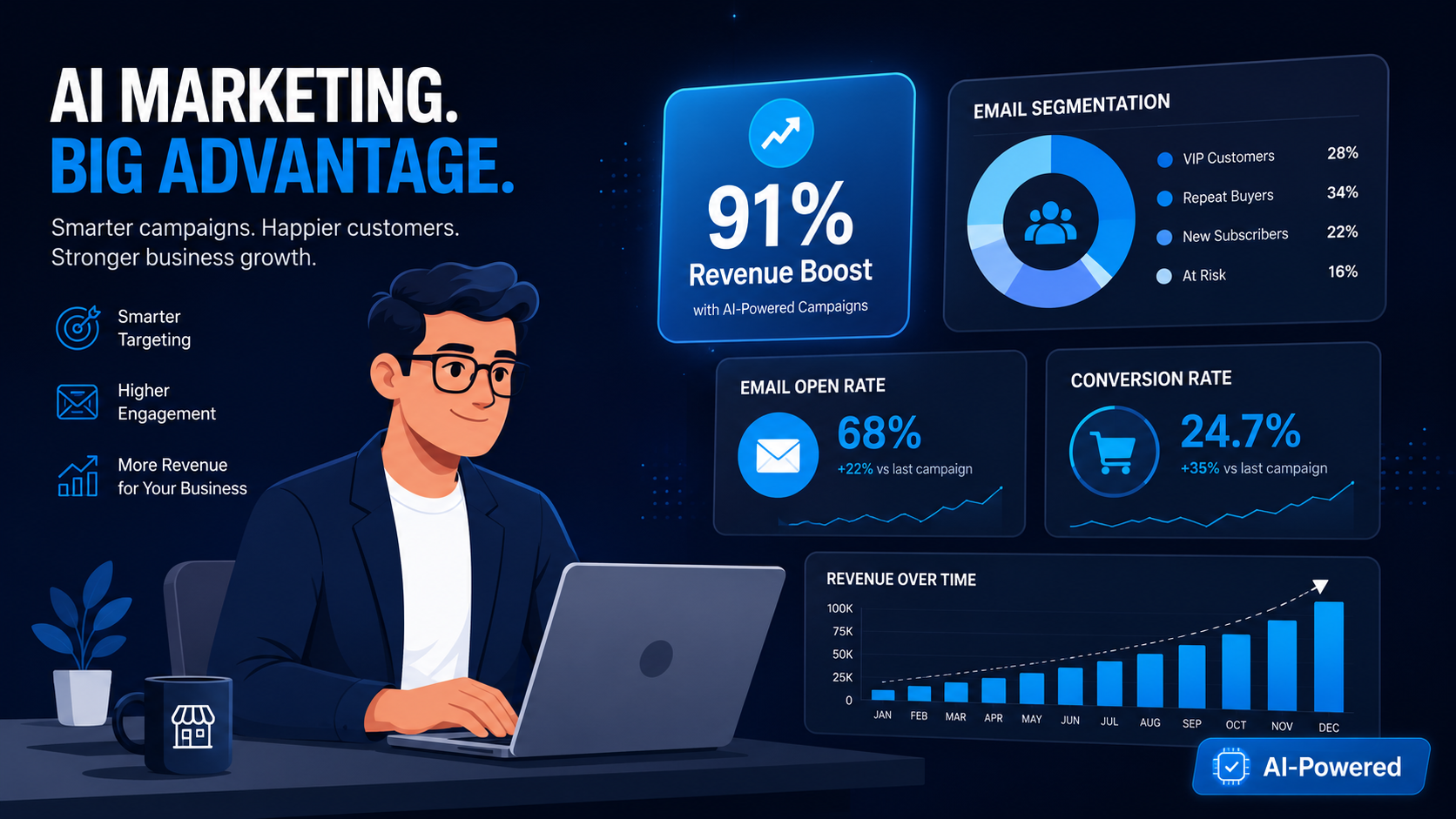
Salesforce’s Small and Medium Business Trends Report surveyed 3,350 SMB leaders worldwide and found that 91% of those already using AI reported revenue boosts. Let me be specific about what that means, because the number gets misquoted everywhere: ninety-one percent of SMBs who adopted AI say it contributed to revenue growth. That’s not a 91% increase. It’s a near-universal signal that once small businesses actually turn on these tools, the results follow. And the area generating the most measurable impact? AI marketing for small business. Not because it’s flashy. Because it finally gives owners the ability to compete with companies running ten times their marketing budget.

The Marketing Asymmetry Problem That AI Marketing for Small Business Is Closing

Here’s the fundamental challenge. A regional dental practice and a corporate dental chain are competing for the same patients in the same zip code. The chain has a marketing director, a content team, a paid media buyer, analytics dashboards, and a CRM that triggers personalized follow-ups. The independent practice has Dr. Sarah, who’s also the CEO, head of HR, and the person who remembers to post on Instagram every other Thursday.

This asymmetry has existed forever. What’s changed is that AI-powered marketing for SMBs is compressing the gap. Not eliminating it. Compressing it. And in competitive local markets, compressing that gap even a little can shift market share.
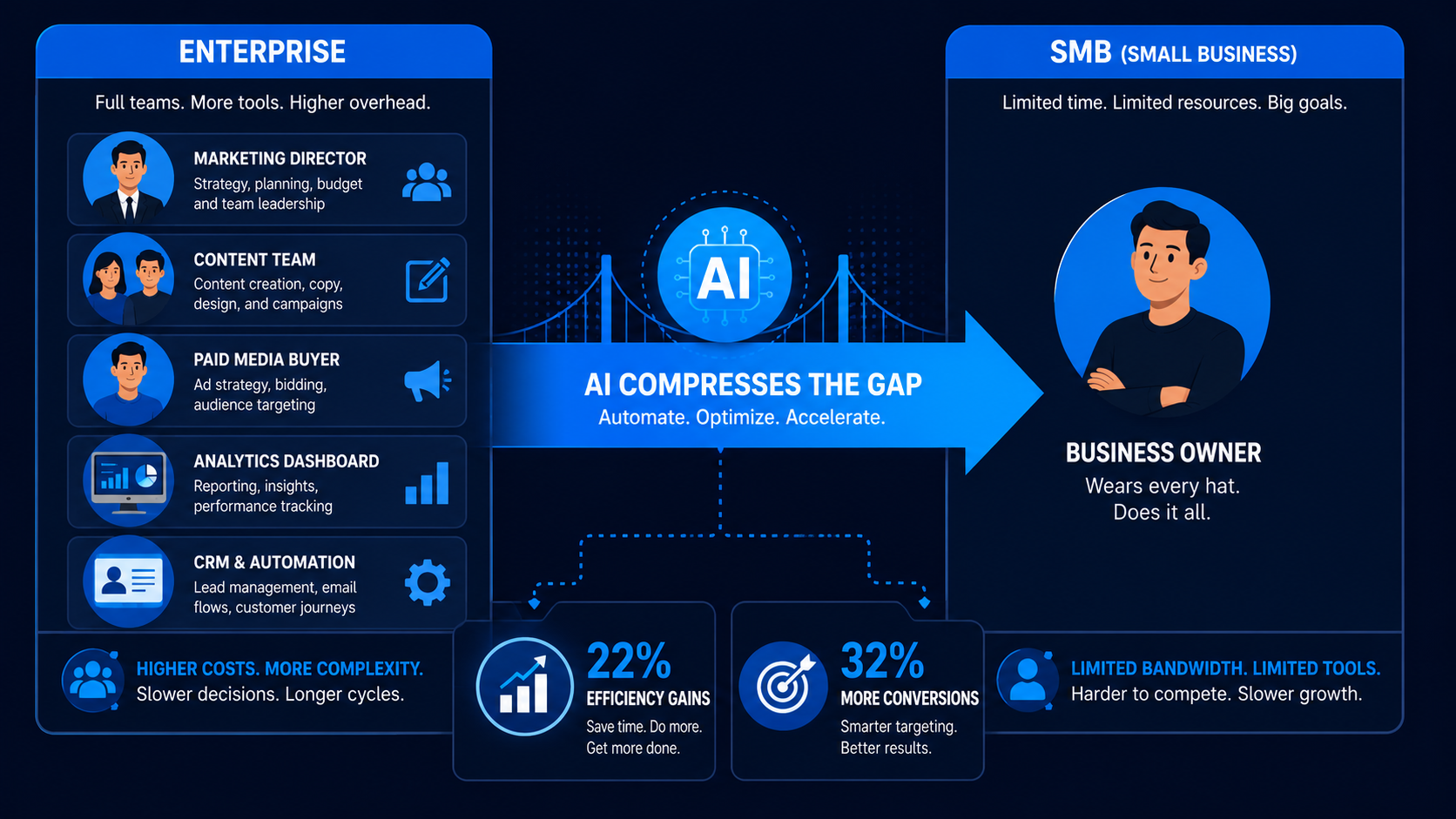
The gap between enterprise and SMB marketing is closing — AI is what’s doing the compressing.

McKinsey’s State of Marketing Europe 2026 report found that companies with mature generative AI implementations are seeing 22% efficiency gains, which they often reinvest directly into growth. Separate research aggregated across campaigns shows AI-driven marketing delivering 32% more conversions and measurably lower customer acquisition costs. Those numbers aren’t exclusive to enterprise companies. They’re baked into tools that cost less than a monthly phone bill.

The question isn’t whether the technology works. It’s whether you’ll pick it up before the practice down the street does.

AI Personalization for Business: The Biggest Advantage for Small Teams

A business owner I work with runs an e-commerce company selling artisanal kitchen products. About $2 million in revenue, five employees. She’d been sending the same monthly newsletter to her entire customer list for three years. Same email. Same format. Same results: around 18% open rate, 2% click-through.

I asked if she’d tried segmenting her list and personalizing the content. She looked at me like I’d suggested she learn quantum physics on a Tuesday. “With what team?” she said.

Fair point. But that’s not really the answer anymore.

What’s changed is that the tools do the segmentation for you. They look at what your customers bought, what they browsed without buying, how long it’s been since they opened an email — and they build the audience groups automatically. You don’t need a marketing team to run that. You need about an afternoon to set it up.

HubSpot ran an internal test a while back — GPT-4 doing one-to-one email personalization at scale, the kind of thing that used to require a dedicated team. Conversion rates went up 82%. Open rates climbed 30%. Click-through jumped over 50%. And to their credit, their VP of Marketing published the whole process, including the early rounds that didn’t go as planned. That kind of transparency is rare in a case study, and it’s part of why I trust the numbers.

What happens when you let AI handle segmentation: real numbers from real implementations.

The Data and Marketing Association found that segmented email campaigns generate up to 760% more revenue than non-segmented ones. AI-powered email marketing has shown an average 41% increase in revenue across implementations tracked by industry analysts. And automated email flows consistently achieve conversion rates roughly four times higher than manual campaigns.

The tools to do this are no longer enterprise-only. Platforms like Klaviyo, Mailchimp (with its AI features), ActiveCampaign, and HubSpot’s Starter tier all offer AI-driven segmentation and content personalization. Most start under $50 a month. The kitchen products owner I mentioned? She switched to AI-driven email flows, and within 90 days, her click-through rate had tripled. She didn’t hire anyone. She let the software do what it was designed to do.

AI doesn’t replace marketing strategy. It replaces the parts of marketing that drain your time without requiring your judgment: the segmentation, the scheduling, the A/B testing, the bid optimization.

AI Lead Generation: Smarter Targeting Without Burning Your Ad Budget

If you’re running paid ads for your business, think about something uncomfortable for a moment. How much of your ad spend is going to people who will never buy from you?

For most small businesses, the answer is “a lot.” You set up a Facebook or Google campaign, pick targeting options that seem right, write ad copy based on instinct, and hope for the best. Maybe you get a decent cost per lead. Maybe you get a bunch of tire-kickers who clog your pipeline and waste your time.

AI lead generation tools change this by analyzing your existing customer data to build predictive models of who’s most likely to convert. Ad targeting is optimized in real-time by adjusting bids, audiences, and creative based on what’s working. Organizations using AI for lead generation have reported up to 50% increases in qualified leads while simultaneously reducing cost per acquisition.

Predictive lead scoring is one of the most underused small business AI marketing tools I come across. Companies using it report significantly higher lead-to-opportunity conversion rates. The tool looks at every lead that comes in and assigns a score based on how closely they match your best existing customers. Your sales team stops chasing cold prospects and starts calling the people who are ready to buy.

Predictive lead scoring: fewer wasted calls, more closed deals.

Salesforce’s own internal experiment illustrates the scale of what’s possible. Their sales team used AI agents to contact 130,000 previously untouched leads over four months, generating 3,200 new opportunities. These were leads that would have been ignored entirely without AI doing the outreach. For a small business, even a fraction of that recovery rate on neglected leads can change quarterly revenue.

Content at Scale Without Losing Your Voice

I’ll be direct about something: most AI-generated marketing content is mediocre. You can spot it from across the room. It reads like a corporate brochure written by a committee.

But AI content tools aren’t supposed to replace your voice. They’re supposed to give you a first draft to work with instead of a blank page. That’s a fundamentally different use case, and when you treat it that way, the productivity gains are real. Ninety-three percent of marketers using AI for content say it accelerates their creation process, according to industry surveys tracked through 2026.

For an SMB owner, this looks like: AI generates a draft blog post based on a topic you provide. You spend fifteen minutes editing it to sound like you. AI creates three email subject line variants. You pick the best one and tweak it. AI writes social media captions for the week. You approve the good ones and delete the rest.

The tools that work best for this are the ones you’re probably already aware of: ChatGPT, Claude, Jasper, and the built-in AI features inside platforms like HubSpot and Canva. The key is using them as a starting point, not a finish line. A Billion Dollar Boy study found that consumer preference for AI-generated creator content dropped from 60% in 2023 to 26% in 2025. People can tell when nobody human has touched the output. Your job is to be the human who touches it.

Where AI Marketing Automation Falls Apart: The Integration Problem

The most common failure mode I see with AI marketing automation isn’t the AI itself. It’s disconnected systems.

Your email platform doesn’t talk to your CRM. Your ad platform doesn’t share data with your website analytics. Your social media scheduler has no idea what your sales team is hearing from prospects. So the AI in each tool is optimizing in its own silo, without the full picture.

Connected systems multiply AI effectiveness. Siloed tools cancel each other out.

Growing SMBs are nearly twice as likely to have integrated tech stacks compared to declining ones, according to Salesforce’s findings. That’s not a coincidence. When your systems share data, every AI tool in the chain gets smarter. When they don’t, you’re running five separate AI tools that each see a fraction of the picture. Bain’s 2025 research reinforces this: companies with fully integrated AI stacks achieve twice the cost efficiency gains of those running disconnected point solutions.

If you’re going to invest in AI for SMB marketing, start by mapping your data flow. Where does customer information originate? Where does it go? Where does it stop? Platforms like Zapier, Make, and n8n can bridge gaps between tools without custom development. But the mapping needs to happen first. Otherwise you’re automating a broken process, which only makes it break faster.

The Ethics of AI Personalization for Business: Knowing When to Pull Back

There’s a line between personalization and surveillance, and AI makes it easy to cross without realizing it. When your email platform knows what pages a customer browsed at 11 PM, what products they put in their cart and removed, and how many times they’ve opened your last six emails, you have a lot of power. Using it well means sending a relevant recommendation at the right time. Using it poorly means making your customers feel watched.

Here’s the tension in the data. McKinsey found that 71% of consumers expect personalized interactions from the brands they buy from. That’s a real expectation, not a preference. But a 2026 Gartner survey found that 53% of those same consumers distrust AI-powered search results. And Klaviyo’s research put it more sharply: 39% said they’d trust a brand less for using AI-generated content without disclosing it.

So people want personalization and they’re skeptical of the AI delivering it. I don’t think that’s a contradiction. It’s a calibration problem. They want to feel known, not tracked. That distinction sounds subtle until your business is on the wrong side of it.

My advice: be transparent about what you collect and why. Give customers control over their preferences. Don’t optimize so aggressively that your marketing feels predatory. A well-timed helpful email builds trust. A retargeting ad that follows someone around the internet for three weeks after they glanced at a product page destroys it.

Where to Start This Week with Small Business AI Marketing Tools

Pick one channel. That’s it. Not three. One.

If email is your primary channel: Go into your email platform and turn on segmentation if it’s not already running. Klaviyo, Mailchimp, and ActiveCampaign all include it — most people just haven’t set it up. Start with three segments: people who bought in the last 90 days, people who haven’t opened an email in six months, and everyone else. Send different content to each group for 30 days. Don’t judge it before then. The algorithm needs time to sort itself out.

If you’re running paid ads: Turn on the AI optimization your ad platform already offers before you touch anything else. Google’s Performance Max and Meta’s Advantage+ both use machine learning to optimize targeting and creative on their own — but they need room to run. Give it two full weeks before you evaluate. I know that feels like a long time when you’re watching spend. But if you intervene too early, you reset the learning cycle and the whole clock starts over.

If content creation is your bottleneck: Dedicate one hour to setting up a content workflow with ChatGPT or Claude. Spend some time creating a custom instruction set that reflects your brand voice, typical customer questions, and industry terminology. Use AI for first drafts only. Your editing pass is what makes it yours.

If you want the full picture: Audit your current marketing stack. List every tool and identify where data is shared and where it’s siloed. The gaps in that map tell you exactly where integration work will create the most value for AI marketing automation.

The 91% revenue signal from Salesforce’s research isn’t about companies that bought a tool and sat back. It’s about businesses that identified specific marketing problems, picked tools that addressed those problems, and iterated. Start with one channel. Prove the value. Then expand.

Good decisions start with good information. Galyx is built for the business owner who knows AI matters and needs a technology partner to guide them through it.

Register at Galyx.com for more insights and guidance.

Share
George Papazian
About the author
George Papazian
Founder & AI Strategy Consultant, Galyx

30+ years of research strategy on projects for Oracle, Cisco, PayPal, and Walmart — now helping small businesses adopt AI that actually delivers.

More about George →
Related posts

Keep reading