
AI-Driven Revenue Boost: How SMBs Are Seeing 81% Growth with Smart Sales Tools

AI sales tools are delivering 81% revenue growth for SMBs. Discover which smart CRM features, lead scoring, and automation strategies actually work for small teams in 2026.
I was having lunch with another business owner last week. He runs a commercial cleaning company with about thirty employees and a solid client list. Halfway through lunch, he looked up and said, "I keep hearing that AI is supposed to help with sales. But every time I look into it, it feels like it's built for companies with a hundred salespeople and a seven-figure tech budget."
I understand that frustration. I hear it constantly. The headlines about AI sales tools tend to feature Fortune 500 case studies and enterprise dashboards that look like mission control at NASA. Not exactly relatable when you're running a team of five and your CRM is a shared spreadsheet that your office manager set up in 2019.
But here's what my friend didn't know, and what most small business owners still don't: the gap between what large enterprises have access to and what's available to a ten-person company has shrunk dramatically. Some of it has disappeared entirely. Recent research paints a picture that's hard to ignore. Sales teams using AI report 81% revenue growth. They're 1.3 times more likely to see their earnings climb compared to teams that aren't using these tools. And conversion rates? Up by as much as 30%.
Those aren't numbers reserved for companies with deep pockets. They're showing up in small and mid-sized businesses that figured out how to plug the right tools into their existing workflows. Let me walk you through what's working, what it costs, and where the real pitfalls are.
The Numbers Behind the AI-Driven Revenue Growth
Let's start with the data, because the claims floating around social media range from reasonable to absurd. I spent time sorting out what's credible.
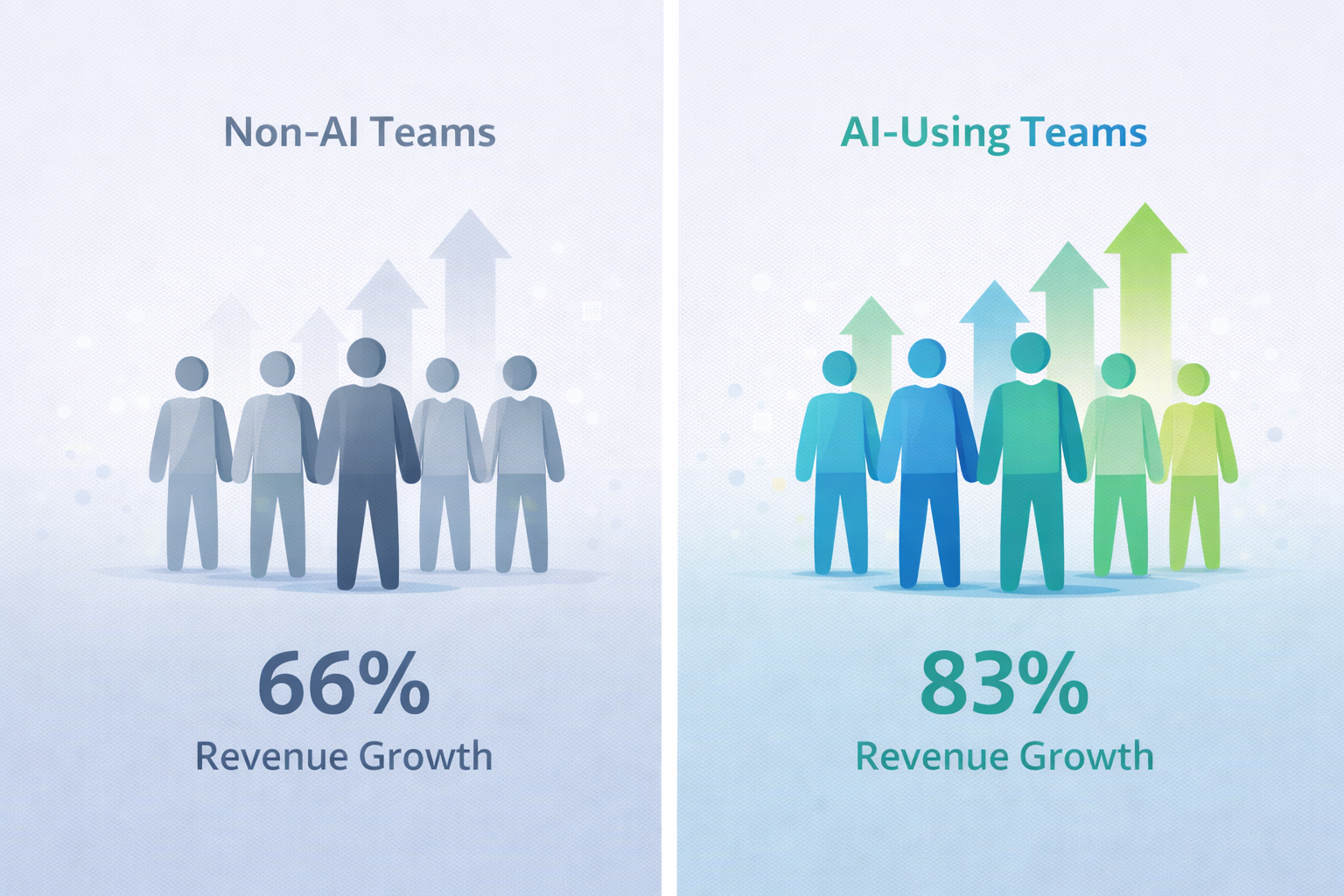
According to research from Salesforce and Sopro, 81% of sales teams are now either experimenting with or have fully deployed AI tools in their sales processes. That's not a projection. That's current adoption. And the performance gap between AI-using teams and everyone else is widening. Eighty-three percent of sales teams using AI reported revenue growth, compared to 66% of teams that haven't adopted these tools. That's a 17-point spread, and it's growing.
Here's where it gets interesting for smaller operations. A 2025 survey found that 75% of small businesses have already invested in some form of AI tooling. They're not all using it for sales specifically, but the infrastructure is there. The companies that are applying AI to their sales pipeline are seeing results like 50% more sales-ready leads, up to a 60% reduction in lead acquisition costs, and deal cycles that close measurably faster.
One stat that caught my attention: companies applying AI to lead prioritization report up to 50% higher revenue growth than their peers. Not 5%. Not 10%. Fifty percent. That's the kind of number that makes you put down your coffee and pay attention.
What Smart Sales Tools Actually Do (in Plain English)

30+ years of research strategy on projects for Oracle, Cisco, PayPal, and Walmart — now helping small businesses adopt AI that actually delivers.
More about George →Keep reading

AI renders faster and drafts proposals in minutes. But building codes, site conditions, professional liability, and field decisions remain structural limits no model handles.

Only 43% of associations can access their own member data. AI cannot fix what it cannot see. A practical guide to fixing the data foundation before buying AI features.

Solo architects and small design firms spend too many hours writing proposals that look like last month’s. AI can cut the assembly