← Back to Blog

Turning Social Media Scrolling into Sales with AI Analytics

By George PapazianJune 20, 20267 min read
AI ToolsAnalyticsMarketingSalesSEOStrategy
Turning Social Media Scrolling into Sales with AI Analytics

Stop counting likes. AI social media analytics now connects your posts to actual revenue. Here’s the practical guide with tools at every budget level.

Do you know what your most profitable customer type actually looks like? Not your guess. The data answer. Most business owners I work with don’t. They can tell me who their biggest client is, or which product sells the most units, but when I ask them to describe the customer who generates the most profit per dollar of marketing spend, they go quiet.

That question is the starting point for everything I’m about to write. Because the gap between the marketing you’re doing and the revenue it’s producing is where most small businesses lose money without ever realizing it. And nowhere is that gap wider, or more fixable, than on social media.

I talk to business owners every week who are posting five days a week across three platforms. Their content looks sharp. Engagement seems decent. But ask them which posts are driving actual revenue, and you get the same answer almost every time: “We get likes. People comment. But I genuinely don’t know which posts bring people through the door.”

That’s the norm. Most small businesses treat social media like a megaphone when it should be a microscope. They broadcast content, check vanity metrics like follower counts, and have almost no visibility into what’s working, what’s wasting time, and where the money goes.

Here’s what changed: AI social media analytics can now connect the dots between that Instagram Reel your team posted Tuesday and the three customers who booked appointments Wednesday. Not in theory. With tools that exist right now and that most small businesses can afford.

The Numbers Behind the Shift in AI Social Media Analytics

Sociality.io runs an annual survey of social media marketers. Their 2026 report found that nearly 90% now use AI in their social media work daily or several times a week. That tracks with what I’m seeing in the field.

The top use case surprised me, though. Almost 60% of respondents cited analytics and reporting as their primary AI application. Not content creation. Not scheduling. Measurement. The industry figured out what I’ve been telling clients for two years: the value isn’t in posting more. It’s in understanding what’s already working.
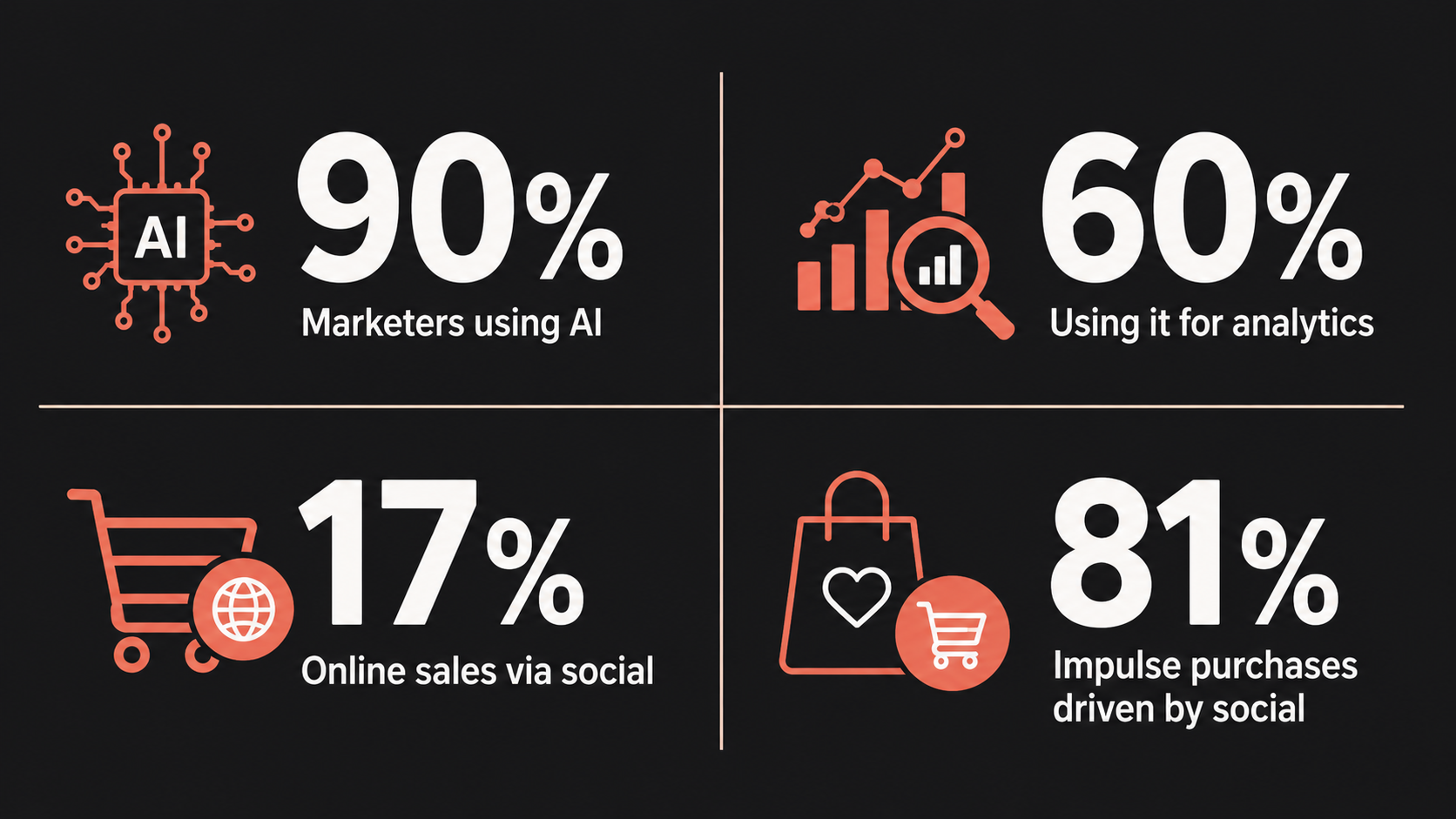
The numbers behind the shift to AI-powered social media measurement.

Sprout Social’s research adds another layer. Social platforms drove 17% of all online sales in 2025. That’s not engagement or brand awareness. That’s real money that moved through social channels to a checkout page.

Roughly 81% of consumers say social media pushes them into impulse purchases multiple times a year. I read that number twice. Eighty-one percent.

Meanwhile, CoSchedule’s State of AI in Marketing report found that marketers using AI are about 25% more likely to report measurable success with their content than those who don’t. When you’re working with tight margins and a lean marketing team, a 25% performance edge isn’t academic. It’s the difference between growing and treading water.

What AI Social Media Analytics Does That You Can’t Do Manually

I want to be specific here because “AI analytics” can sound like a buzzword if you don’t break it down. There are four things AI-powered social media marketing tools do that manual analysis can’t match.

Sentiment Goes Beyond Thumbs Up

Traditional analytics tells you a post got 200 comments. AI tells you that 140 expressed excitement about your new product, 35 were pricing questions, and 25 were complaints about shipping times. Those are three completely different signals hiding behind one number.

I had a client last year who was celebrating an Instagram post that got triple their normal comment count. When we ran sentiment analysis on those comments, more than a third were complaints about a delayed shipment. The post wasn’t a win. It was an early warning they almost missed.

Tools like Sprout Social and Hootsuite (which acquired Talkwalker, a dedicated social listening platform, back in 2024) now offer sentiment analysis that reads the emotional tone of comments and messages. For a small business, that means you can spot a service problem before it becomes a crisis.

Pattern Recognition at Scale

Your team might manage 20 posts a week. AI analyzes thousands. It searches across your entire posting history and surfaces patterns no human would catch. Maybe your product demonstration videos posted in the early evening on Tuesdays consistently drive more website clicks than anything else. Maybe your behind-the-scenes content gets engagement but zero conversions.

Those patterns exist in your data right now. You just can’t see them without help.

From impressions to revenue: how AI analytics tracks the full customer path.

Predictive Timing and Content Optimization

Most scheduling tools will tell you the “best time to post” based on generic averages. AI analytics tools for small business go further. They analyze your specific audience’s behavior and predict when your followers are most likely to act, not just scroll past.

Hootsuite’s AI scheduling, for example, lets you set goals (more reach versus more engagement versus more traffic) and adjusts timing accordingly. That level of specificity used to require a dedicated data analyst. Now it’s a feature in a mid-tier subscription.

Attribution That Follows the Money

This is the one that matters most. Attribution means connecting a specific social media post or campaign to actual revenue. Did that Facebook ad lead to a sale? Did that Instagram Story generate a booking?

Traditional analytics gives you impressions and clicks. AI social media analytics connects those clicks to conversions and tracks the customer through the funnel. You can see which content actually generates return. I’ve watched clients go from “we think social media helps” to “this content format produces $4 of revenue for every $1 we spend on it.” That’s a different conversation entirely.

The gap between scrolling and selling has never been narrower. AI analytics is the bridge that connects your social media posts to your cash register.

The Social Media Analytics Tools Worth Looking At

I’m going to give you general guidance on tool tiers rather than exact prices, because pricing in this category changes every few months and I don’t want this post to age badly by next quarter.

For Solopreneurs and Microbusinesses

Buffer and Metricool are both solid entry points at the lowest price tier in the market. You won’t get sentiment analysis or deep AI insights, but you’ll get posting analytics and engagement tracking. That’s enough data to start making informed decisions about what’s working. If you’re spending nothing on analytics right now, either of these gets you off zero for less than the cost of lunch.

Social media AI tools for small business at every budget level.

For Growing Businesses

This is where social media AI tools for small business get interesting. Hootsuite’s standard plans now include social listening after the Talkwalker acquisition. Even their entry-level customers get sentiment analysis and brand mention tracking. Two years ago, that combination would have cost three or four times what it costs today.

Agorapulse is another strong option at a similar price point. Their ROI reporting connects social media activity to Google Analytics data, which means you can trace the path from a social post to a website visit to a conversion. I’ve used this with clients who needed attribution without the enterprise price tag, and it delivered.

For Serious Operations

Sprout Social sits at the higher end of the small business range, and I’ll be direct: it’s the best analytics platform I’ve seen for businesses that need executive-ready reporting. Their AI listening tools give you competitive benchmarking and brand sentiment in real time. Plug in the CRM integration, and you can tie those insights back to individual customer relationships. The cost stings for a small operation. But if social media is a primary revenue channel, better analytics pays for itself through better decisions. I’ve seen it happen with three separate clients in the past year.

Brand24 and Brandwatch are worth knowing about if social listening is your primary need. Brand24 has an accessible entry price for basic monitoring. Brandwatch is enterprise territory, but it offers the most comprehensive sentiment and trend analysis available.

Getting Started with AI-Powered Social Media Marketing

I know from experience that most business owners reading a post like this will agree it makes sense and then do nothing. Not because they’re lazy. The gap between understanding and implementation feels too wide. So let me narrow it.

Four weeks from zero analytics to a data-driven social strategy.

First week: Pick one tool. If you’re spending nothing on analytics right now, start with Buffer or Metricool. If you already have a scheduling tool, check whether it has analytics features you’re not using. Most do. Connect your accounts and let data start flowing.

Second week: Identify your top three performing posts from the last 90 days. Not by likes. By whatever metric is closest to revenue: website clicks, direct messages asking about pricing, booking link taps. Those three posts tell you what your audience wants to buy, not just what they want to look at.

Third week: Create three new posts modeled on those top performers. Same format, similar topic, posted at similar times. Track the results. You’ve just built a basic feedback loop, which is the foundation of any AI-powered social media marketing strategy.

Fourth week: Evaluate whether you need a more capable tool. If you’re seeing patterns but can’t dig deeper, that’s your signal to upgrade. If your current tool meets your needs, stick with it. I’ve told more than one client to stay on a lower-tier plan when the numbers didn’t justify moving up. That matters.

Where AI Social Media Analytics Falls Short

I’d be doing you a disservice if I didn’t talk about the gaps. Sociality.io’s same 2026 report found that half of marketers are concerned about the accuracy and reliability of AI-generated insights. That concern is legitimate. These tools are only as good as the data they’re fed, and if your tracking pixels are broken, your UTM parameters inconsistent, or your CRM disconnected, the insights will be incomplete or misleading.

Privacy regulations are also tightening globally. More than 170 countries now have some form of data privacy law on the books, and the trend is toward stricter enforcement. The data available for social media targeting and analytics is shrinking year over year. First-party data, the information your customers give you directly, is becoming more valuable than third-party tracking data. That means your email list and customer database are increasingly important inputs for your social strategy.

And let me be real about the learning curve. These tools are getting more intuitive, but they still require setup time, consistent use, and a willingness to look at the data and adjust. The AI won’t do the thinking for you. It gives you better information to think with.

Looking Forward

I worked with a client earlier this year who’d been posting across three platforms five days a week. Good content. Decent engagement. No idea what was generating revenue. We set them up with a mid-tier analytics platform and told them to focus on one metric: which content formats drove the most pricing inquiries.

Within two months, they found that short, practical tip videos posted midweek drove nearly half their new customer inquiries. They stopped producing the image-heavy posts that collected plenty of likes but generated no leads. Their social media person went from posting five days a week to three, with content that was targeted and tracked. Marketing costs went down. Revenue attribution went up.

That’s the shift happening right now. Not more content. Better content. Not more data. The right data. The businesses that figure out how to connect their social media activity to their sales pipeline will pull ahead of those still counting likes and hoping for the best.

The tools are accessible. The data is available. The question is whether you’re going to keep treating social media like a megaphone or start using it as the microscope it’s become.

Good decisions start with good information. Galyx™ is built for the business owner who knows AI matters and needs a technology partner to guide them through it.

Register at Galyx.com for more insights and guidance.

Share
George Papazian
About the author
George Papazian
Founder & AI Strategy Consultant, Galyx

30+ years of research strategy on projects for Oracle, Cisco, PayPal, and Walmart — now helping small businesses adopt AI that actually delivers.

More about George →
Related posts

Keep reading